When something on your payslip is wrong, the law is on your side - but only if you raise the issue properly. This guide walks through how to spot a payroll error, how to write a formal letter that gets results, and what to do if your employer ignores you. There is a copy-paste template lower down. We focus on the UK system and the 2026/27 thresholds.
To check whether the tax, NI and PAYE lines look right on your own slip, see How do I check my payslip is correct?.
Want to check if your own payslip adds up?
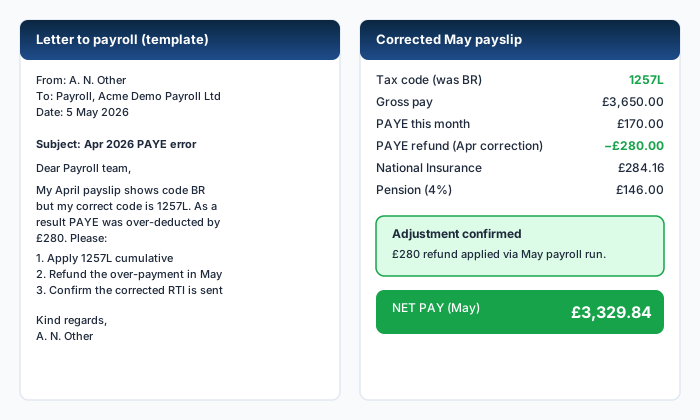
Step 1: confirm the error before you escalate
Before sending anything in writing, sanity-check the payslip yourself. The most common payroll "errors" that turn out to be correct are:
- Higher-than-expected tax in the month a bonus is paid (cumulative PAYE catching up)
- Lower-than-expected pay in a part-month after a mid-month start
- Tax code change after HMRC issued a P9 (look for an HMRC letter)
- Holiday pay paid as accrued rather than booked
Run the figures through PayslipIQ's free payslip checker before you send a formal complaint - it takes two minutes and avoids embarrassment.
The errors that are usually genuine
Real payroll errors most often involve:
- Hours not paid (especially for hourly workers and zero-hours)
- Overtime calculated at single rate instead of time-and-a-half
- Statutory pay (SMP/SPP/SSP) underpaid or missed
- Pension contributions taken but not paid into the scheme
- Wrong NI category letter applied
- Salary sacrifice deducted twice
These are governed by the Employment Rights Act 1996, which classifies any underpayment as an "unlawful deduction from wages".
Step 2: raise it informally
Always try the friendly route first. Email your line manager and HR with:
- Your full name and payroll number
- The pay period in question
- The exact amount you believe is wrong
- Calculation showing your expected figure
Give them five working days to respond. Most genuine errors are fixed in the next pay run.
Keep every email. If the dispute progresses to Acas or an employment tribunal, your written record is the most important piece of evidence you have.
Step 3: send a formal grievance letter
If the informal approach fails, escalate to a written grievance under the Acas Code of Practice on Disciplinary and Grievance Procedures. The letter should be addressed to HR or the named person in your contract's grievance clause.
The letter template
Copy and adapt the wording below. Keep it polite, factual, and free of emotional language - tribunal panels read these letters and tone matters.
[Your full name] [Payroll number] [Date]
[HR Manager / named person] [Employer name and address]
Dear [Name],
Re: Formal grievance - underpayment of wages, pay period ending [date]
I am writing to raise a formal grievance under our company's grievance procedure regarding what I believe is an underpayment of my wages.
The facts are as follows:
- My gross pay for the period ending [date] was £[X], net pay £[Y].
- According to my contract, my expected gross pay for that period is £[Z].
- The shortfall is £[Z minus X]. My calculation is attached.
- On [date] I raised this with [manager name] by [email/in person]. I have not received a response / the response was [summary].
Section 13 of the Employment Rights Act 1996 makes any unauthorised deduction from wages unlawful. I would be grateful if you could:
- Investigate the discrepancy
- Confirm in writing whether my calculation is correct
- Process a corrective payment in the next available pay run, with a payslip showing the adjustment
Please treat this as a formal grievance. I would like to meet to discuss it within ten working days, in line with the Acas Code of Practice. I reserve my right to be accompanied by a colleague or trade union representative.
If the matter cannot be resolved internally, I will consider escalating to Acas Early Conciliation and, if necessary, an employment tribunal claim under sections 13-23 of the Employment Rights Act 1996.
Yours sincerely,
[Signature] [Printed name]
Worked example: calculating the shortfall
Suppose you earn £36,000 a year, paid monthly. Your March 2027 payslip shows gross £2,700 instead of £3,000.
- Annual gross: £36,000
- Expected monthly gross: £36,000 / 12 = £3,000
- Actual gross: £2,700
- Underpayment (gross): £300
- After tax (20%) and NI (8%): the net loss is roughly £300 × 0.72 = £216
You attach the maths to the letter so HR cannot dispute the amount.
Step 4: Acas Early Conciliation
If the grievance is rejected or ignored, the next step is Acas Early Conciliation. This is free, neutral, and required before you can lodge a tribunal claim.
- Submit an Acas EC notification online or by phone (0300 123 1100)
- Acas contacts the employer to try to settle the dispute
- The conciliation period lasts up to 12 weeks (Acas)
- Most cases settle here
You must contact Acas within your tribunal time limit, which is the one set out in the box below and is not always three months. Acting fast is essential: notifying Acas late does not extend it.
The tribunal time limit is strict: miss it and you usually lose the right to bring a claim however strong it is. The time limit is changing on 1 October 2026. Where the time limit starts on or after that date, you have 6 months less 1 day to bring a claim; where it started before, the old 3 months less 1 day still applies (Acas). If your payday sits either side of 1 October 2026, work to the earlier deadline unless you have taken advice. As soon as you are convinced the error will not be corrected, contact Acas.
Step 5: tribunal claim if all else fails
If conciliation fails, Acas issues a certificate and you can lodge an ET1 claim with the employment tribunal. There is no fee. Cases for unlawful deduction from wages typically settle or are decided within 6-12 months.
You can claim:
- The shortfall itself
- Interest on an unpaid award at the Judgments Act rate of 8% a year, running from 42 days after the decision is sent out
- Up to two years of historic underpayments under the Deduction from Wages (Limitation) Regulations 2014
The tribunal cannot award general damages for stress or inconvenience in a deductions claim - it is strictly about money owed.
Common payroll errors to look out for on your payslip
Spotting these early saves a tribunal trip:
- Tax code changes you did not expect - cross-reference with our emergency tax codes guide
- NI category changes - see NI category letters
- Statutory pay missing during family leave or sickness
- Pension contributions deducted but not on the scheme statement
- Year-to-date totals not matching previous payslips - read our YTD guide
You can run any payslip through our free checker to spot maths errors automatically.
Frequently Asked Questions
How long does my employer have to fix a payroll error?
There is no statutory deadline, but the Acas Code of Practice says grievances should be handled "without unreasonable delay". In practice, ten working days for a response and the next pay run for a correction are reasonable expectations.
Can my employer deduct an overpayment from a future payslip?
Yes - section 14 of the Employment Rights Act allows an employer to recover an overpayment without your consent. They should still notify you and ideally agree a repayment schedule rather than deducting the lot in one go.
Do I need a solicitor to raise a payroll error?
No. The grievance, Acas EC and tribunal stages are all designed to be handled without a lawyer. Trade union members can usually get free representation. Citizens Advice and the Acas helpline are also free.
What if I have already left the employer?
You can still raise a grievance and, if needed, take the matter to Acas and tribunal. The same time limit applies as for a current employee, counted from the date the unlawful deduction occurred: 6 months less 1 day where that date falls on or after 1 October 2026, and 3 months less 1 day where it falls before.
What if my employer claims the error is HMRC's fault?
Some errors do originate at HMRC (for example a wrong tax code). The employer is not liable for that, but they must process your refund through PAYE once the corrected code arrives. If they refuse, that is a separate grievance.
Sources
Ready to check your own payslip?
Enter your figures and get an instant AI-powered analysis. Free, private, no signup.
Check my payslip freePayslipIQ provides educational information and estimated calculations only. It does not provide tax, legal, financial, payroll, accounting, pension, benefits or employment advice. Always verify your payslip, tax code, deductions and take-home pay with your employer's payroll department, HMRC, your pension provider, a qualified accountant, tax adviser or another appropriately qualified professional.