If your payslip shows a larger tax deduction than usual, there is almost always a specific reason. Tax in the UK is calculated cumulatively, so a spike in one month does not necessarily mean an error. This guide covers the most common causes and what you can do about each one.
To check whether the tax, NI and PAYE lines look right on your own slip, see How do I check my payslip is correct?.
Want to check if your own payslip adds up?
You received a bonus or overtime pay
The most frequent reason for a higher-than-usual tax deduction is additional earnings in the pay period. If you received a bonus, overtime, or commission on top of your normal salary, your gross pay for the month is higher, and the tax on that extra income is deducted in the same period.
Because UK tax is cumulative, the system calculates the total tax due on your earnings from 6 April to the current date, then subtracts what has already been deducted. A bonus in one month increases the cumulative total, resulting in more tax for that period. The good news is that this is not permanent: if your pay returns to normal next month, the tax should drop back too.
Worked example
You normally earn £3,000 per month on tax code 1257L. In October, you receive a £2,000 bonus, making your gross pay £5,000 for the month.
- Cumulative gross pay (months 1-7): 6 × £3,000 + £5,000 = £23,000
- Cumulative Personal Allowance: 7 × £1,047.50 = £7,332.50
- Cumulative taxable pay: £23,000 - £7,332.50 = £15,667.50
- Cumulative tax due at 20%: £15,667.50 × 0.20 = £3,133.50
- Tax already paid (months 1-6): 6 × £390.50 = £2,343.00
- Tax for October: £3,133.50 - £2,343.00 = £790.50
Compared to your normal monthly tax of £390.50, the October deduction is roughly double because of the bonus. For more on how bonuses are taxed, see our guide on bonus tax.
A bonus does not permanently increase your tax rate. The cumulative system ensures that by the end of the tax year, you will have paid the correct total amount of tax on your total earnings. The spike is temporary.
Your tax code changed
HMRC can change your tax code at any point during the year. If your new code gives you a smaller Personal Allowance, your employer will deduct more tax to make up the difference. Common reasons for a code change include:
- A new taxable benefit (company car, private medical insurance)
- HMRC collecting underpaid tax from a previous year
- A change in your estimated income from other sources
Your employer should apply the new code from the date HMRC specifies. The cumulative calculation then adjusts your tax for the year so far, which can result in a noticeably higher deduction in the first month the new code applies.
If you have received a coding notice (form P2) from HMRC, check the details carefully. If you believe the code is wrong, see our guide on what to do if you have the wrong tax code.
You are on an emergency tax code
If you recently started a new job and did not provide a P45, your employer may have applied an emergency tax code. Codes ending in W1 or M1 calculate tax on a non-cumulative basis, which can result in higher deductions because unused allowance from earlier months is not carried forward.
Emergency codes ending in BR or 0T are more severe: they apply no Personal Allowance at all, meaning every pound you earn is taxed.
You crossed a tax band threshold
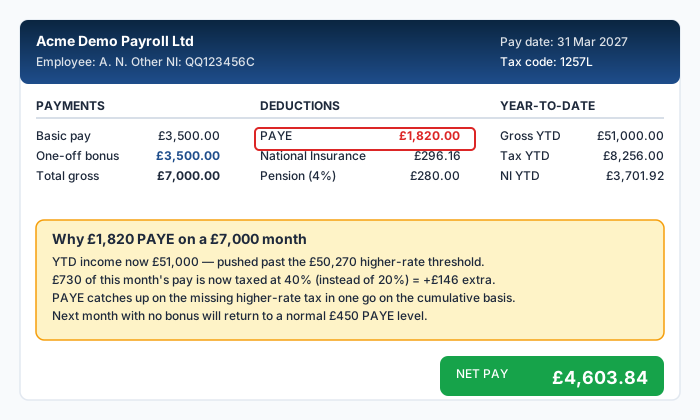
If your cumulative earnings for the year have crossed from the basic rate band (up to £50,270) into the higher rate band (40%), the portion above the threshold is taxed at the higher rate. This can happen mid-year if you receive a pay rise or a large bonus.
For example, if your cumulative earnings reach £50,270 in month 9, any earnings above that point in months 9 to 12 will be taxed at 40% rather than 20%. This can make the tax on those later payslips significantly higher.
If your annual salary is close to £50,270, even a small bonus or overtime payment can push you into the higher rate band for part of the year. The extra tax applies only to the amount above the threshold, not to your entire salary.
Your pension contributions changed
If you reduced your pension contributions (or opted out of auto-enrolment), your taxable pay increases, which means more tax is deducted. Conversely, if you increased contributions through salary sacrifice, your taxable pay decreases and your tax should be lower.
Check whether any pension changes coincided with the higher tax month.
What to do if you cannot explain the increase
If none of the above reasons apply, it can be worth:
- Checking your tax code on the payslip against your most recent HMRC coding notice
- Comparing your gross pay, tax, and NI figures with the previous month
- Running your figures through our payslip checker for a line-by-line comparison
- Asking your payroll department for an explanation
In most cases, the higher deduction has a straightforward explanation. If it turns out to be an error, your employer can correct it in the next pay period.
Frequently Asked Questions
Will I get the extra tax back?
If the higher deduction was caused by a bonus or overtime, the cumulative system will balance it out over the rest of the year. If it was caused by an incorrect tax code, you will receive a refund once the code is corrected, either through your pay or from HMRC.
Does a pay rise mean I pay more tax on all my earnings?
No. The UK uses a marginal tax system. A pay rise that takes you into the higher rate band means only the portion above the threshold is taxed at 40%. Your earnings below the threshold are still taxed at 20%.
My tax code has a K prefix. What does that mean?
A K code means your taxable benefits (such as a company car) exceed your Personal Allowance. Your employer adds the excess to your taxable pay, resulting in higher tax. This is not an error, but you should check the coding notice to ensure the benefit values are correct.
Can I ask my employer to spread the tax on a bonus?
No. Your employer is required to deduct tax in the period the bonus is paid. They cannot spread it over multiple months. However, the cumulative system ensures the annual total is correct.
Should I contact HMRC about a one-month spike?
Not necessarily. If the spike is clearly linked to a bonus, overtime, or a known tax code change, it will resolve itself. Contact HMRC only if you cannot identify the reason or if the higher deduction persists for more than one pay period without explanation.
Sources
Ready to check your own payslip?
Enter your figures and get an instant AI-powered analysis. Free, private, no signup.
Check my payslip freePayslipIQ provides educational information and estimated calculations only. It does not provide tax, legal, financial, payroll, accounting, pension, benefits or employment advice. Always verify your payslip, tax code, deductions and take-home pay with your employer's payroll department, HMRC, your pension provider, a qualified accountant, tax adviser or another appropriately qualified professional.