Bonuses are taxed in exactly the same way as your regular salary. There is no special "bonus tax rate" in the UK. However, because a bonus increases your earnings for the pay period in which it is paid, the tax deduction on that payslip can look disproportionately large. This guide explains why and shows you how to check the figures.
Want to check if your own payslip adds up?
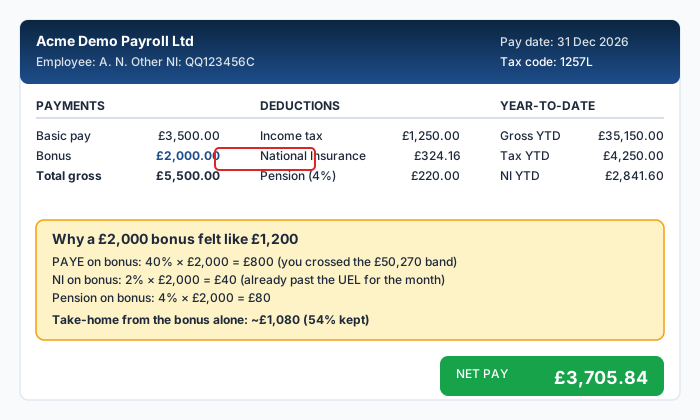
Why your bonus payslip looks heavily taxed
When your employer pays a bonus, it is added to your normal salary for that pay period. The combined amount is then run through the cumulative PAYE calculation. Because your cumulative earnings jump by the bonus amount, the cumulative tax due also jumps, and the difference between what you have already paid and what is now due is collected in that single period.
This is not overtaxation. It is the correct application of the cumulative system. The tax on the bonus is calculated at your marginal rate: the rate that applies to the next pound you earn.
Worked example
You earn £40,000 per year (£3,333.33 per month) on tax code 1257L. In December (month 9), you receive a £5,000 bonus.
- Normal monthly tax: (£3,333.33 - £1,047.50) × 0.20 = £457.17
- December gross pay: £3,333.33 + £5,000 = £8,333.33
- Cumulative gross (months 1-9): 8 × £3,333.33 + £8,333.33 = £35,000.00
- Cumulative Personal Allowance: 9 × £1,047.50 = £9,427.50
- Cumulative taxable pay: £35,000.00 - £9,427.50 = £25,572.50
- Cumulative tax due at 20%: £25,572.50 × 0.20 = £5,114.50
- Tax already paid (months 1-8): 8 × £457.17 = £3,657.36
- Tax for December: £5,114.50 - £3,657.36 = £1,457.14
The December tax of £1,457.14 is roughly three times the normal monthly amount. Of that, £1,000 is tax on the £5,000 bonus (at the 20% basic rate).
There is no separate "bonus tax" in the UK. Your bonus is simply added to your other earnings and taxed at the same rates. The reason the deduction looks high is that the entire tax on the bonus is collected in one pay period rather than being spread across the year.
What if your bonus pushes you into a higher tax band?
If your cumulative earnings for the year cross the higher rate threshold (£50,270), the portion above the threshold is taxed at 40% rather than 20%. This can make the tax on a bonus significantly higher than you might expect.
For example, if your annual salary is £48,000 and you receive a £5,000 bonus, your total becomes £53,000. The first £2,270 of the bonus fills the gap up to £50,270 and is taxed at 20%; the remaining £2,730 sits above the threshold and is taxed at 40%. That is £454 plus £1,092, or £1,546 on a £5,000 bonus - a blended rate of 30.9%.
National Insurance on your bonus
NI is also calculated on the bonus. Because NI is calculated per pay period (not cumulatively), the entire bonus is subject to NI in the period it is paid:
- 8% on earnings between the Primary Threshold and Upper Earnings Limit
- 2% on earnings above the Upper Earnings Limit
If your normal monthly pay plus the bonus exceeds HMRC's monthly Upper Earnings Limit of £4,189, the portion above that is charged at 2% rather than 8%. This is why a large bonus often attracts less NI than people expect.
To check whether those tax, NI and bonus lines look right on your own payslip, see How do I check my payslip is correct?.
A common misconception is that bonuses are taxed at a flat 40% or 50%. In reality, the rate depends on your total earnings for the year. If you are a basic-rate taxpayer and the bonus does not push you into the higher band, it is taxed at 20%.
Can you reduce the tax on a bonus?
You cannot avoid tax on a bonus, but there are legitimate ways to reduce the impact:
- Salary sacrifice into your pension: if your employer allows it, you can sacrifice part of your bonus into your pension before tax and NI are calculated, saving both
- Charitable donations via payroll giving: donations made through Give As You Earn are deducted before tax (but not NI)
- Pension contributions: even if not via salary sacrifice, pension contributions receive tax relief, effectively reducing the tax you pay
These options should be arranged before the bonus is paid. Once it has been processed through payroll, the tax has been deducted and cannot be reversed (except through a pension contribution claimed via Self Assessment).
Will you get the tax back?
If the bonus does not push you into a higher tax band, you will not have overpaid: the cumulative system ensures the correct total is collected. If it does push you into a higher band temporarily (for example, you are a basic-rate taxpayer but the bonus month pushes you into the higher band), the cumulative system will correct this in subsequent months as your earnings return to normal.
You can verify your deductions by running your figures through our payslip checker.
Frequently Asked Questions
Is there a special tax rate for bonuses in the UK?
No. Bonuses are taxed at the same rates as your regular salary. The rate depends on your total earnings for the year and which tax band they fall into.
Why was 40% tax taken from my bonus when I am a basic-rate taxpayer?
Your bonus may have pushed your cumulative earnings above the higher rate threshold for that period. If your earnings return to normal in subsequent months, the cumulative system will adjust and you should not overpay for the year as a whole.
Does my employer choose how to tax my bonus?
No. Your employer is required to follow the PAYE rules set by HMRC. They cannot choose to tax a bonus at a different rate or spread the tax over multiple months.
Can I ask for my bonus to be paid into my pension instead?
Some employers offer this option through salary sacrifice. If yours does, the bonus would go directly into your pension without income tax or NI being deducted. Check with your HR department.
Will my bonus affect my student loan repayment?
Yes. Student loan repayments are calculated per pay period. A bonus increases your gross pay for the period, which may increase the student loan deduction for that month.
Sources
Ready to check your own payslip?
Enter your figures and get an instant AI-powered analysis. Free, private, no signup.
Check my payslip freePayslipIQ provides educational information and estimated calculations only. It does not provide tax, legal, financial, payroll, accounting, pension, benefits or employment advice. Always verify your payslip, tax code, deductions and take-home pay with your employer's payroll department, HMRC, your pension provider, a qualified accountant, tax adviser or another appropriately qualified professional.