Gross pay is what you earn before deductions. Net pay is what lands in your bank account after tax, National Insurance, pension, and any other deductions have been taken off. The gap between the two can be surprisingly large, and understanding where the money goes is the first step to checking that your payslip is correct.
Want to check if your own payslip adds up?
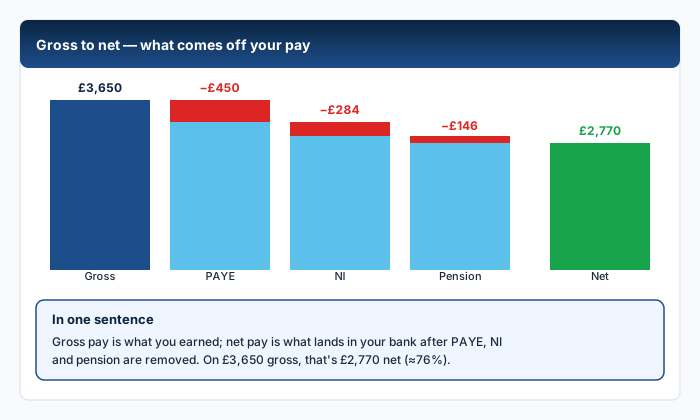
What gross pay includes
Gross pay is the total value of your earnings for the pay period before anything is subtracted. It typically includes:
- Your basic salary or hourly wages
- Overtime payments
- Bonuses and commission
- Statutory payments (sick pay, maternity pay)
- Shift allowances or unsocial hours premiums
If your employment contract states a salary of £30,000 per year and you are paid monthly, your gross pay each month is £2,500.00 (£30,000 / 12). Any additional earnings for that period are added on top.
Salary sacrifice arrangements (such as additional pension contributions or a cycle-to-work scheme) reduce your gross pay before tax is calculated. If you are on a salary sacrifice scheme, your payslip may show a lower gross figure than your contractual salary.
What is deducted to reach net pay
The main deductions that reduce your gross pay to net pay are:
- Income tax (PAYE): calculated using your tax code and the current tax bands
- National Insurance (NI): calculated per pay period at 8% on earnings between £12,570 and £50,270 (annual equivalent), and 2% above that
- Workplace pension: typically 5% of qualifying earnings under auto-enrolment
- Student loan repayments: 9% of earnings above the threshold for your plan type
- Other deductions: union fees, attachment of earnings orders, Give As You Earn donations
Each of these should appear as a separate line on your payslip. If you add them all together and subtract the total from your gross pay, the result should match your net pay.
Worked example
Suppose you earn £32,000 a year in 2026/27, paid monthly, tax code 1257L, NI category A, with a 5% employee pension contribution on qualifying earnings and no student loan. Note the two different monthly thresholds: £1,047.50 is one twelfth of the £12,570 Personal Allowance for income tax, while £1,048 is HMRC's published monthly NI Primary Threshold.
| Item | Calculation | Monthly amount |
|---|---|---|
| Gross pay | £32,000 / 12 | £2,666.67 |
| Pension (5% of qualifying earnings) | (£2,666.67 - £520.00) × 0.05 | £107.33 |
| Taxable pay | £2,666.67 - £107.33 - £1,047.50 | £1,511.84 |
| Income tax (20%) | £1,511.84 × 0.20 | £302.37 |
| NI (8%) | (£2,666.67 - £1,048.00) × 0.08 | £129.49 |
| Net pay | £2,666.67 - £302.37 - £129.49 - £107.33 | £2,127.48 |
In this example, roughly 20% of gross pay goes to deductions. The exact percentage varies depending on your salary, tax code, and pension contributions.
Why the gap matters
The difference between gross and net pay is not just an academic distinction. It affects several practical situations:
- Mortgage applications often ask for your gross salary, but lenders also consider your net income when assessing affordability.
- Budgeting should be based on net pay, since that is the amount you actually receive.
- Pay rises do not translate pound-for-pound into extra take-home pay. A £1,000 gross pay rise for a basic-rate taxpayer with standard NI results in roughly £720 of additional net pay after tax and NI.
- Job offers quoted as gross salary can be misleading if you do not calculate the net equivalent.
A common mistake when comparing job offers is to look only at the gross salary. Two jobs with the same gross pay can produce different net pay if one includes salary sacrifice benefits (which reduce taxable income) and the other does not. It can be worth calculating the net figure for each offer.
How to check your gross-to-net calculation
You can verify the figures on your payslip by working through the deductions manually:
- Start with your gross pay
- Subtract any pre-tax deductions (salary sacrifice pension, cycle-to-work)
- Calculate income tax on the result using your tax code
- Calculate NI on your gross pay (NI is reduced by salary sacrifice arrangements)
- Subtract all deductions from gross pay
If the result does not match your net pay, there may be an error worth investigating. Our payslip checker automates this comparison for you.
To check whether those gross, tax and NI lines look right on your own payslip, see How do I check my payslip is correct?.
Gross vs net on your P60
At the end of each tax year (5 April), your employer issues a P60 showing your total gross pay, total tax paid, and total NI paid for the year. The gross figure on your P60 should match the sum of all your monthly gross pay figures. The tax and NI totals should match the year-to-date figures on your final payslip of the tax year.
If there is a discrepancy, it can be worth raising it with your payroll department before the figures are submitted to HMRC. For more on the differences between payslips, P60s, and P45s, see our guide on payslip vs P60 vs P45.
Frequently Asked Questions
Is gross pay the same as my salary?
For salaried employees, your annual gross pay should equal your contractual salary (plus any bonuses, overtime, or other additions). For hourly workers, gross pay is your hourly rate multiplied by the hours worked in the pay period.
Why is my net pay lower than I expected?
The most common reasons are: a higher tax code deduction than anticipated, NI contributions, pension auto-enrolment (which may have been applied without you realising), or a student loan repayment. Check each deduction line on your payslip individually.
Does gross pay include employer pension contributions?
No. Employer pension contributions are paid by your employer on top of your salary. They do not appear in your gross pay figure and are not deducted from your wages.
How much of my gross pay should I take home?
This depends on your salary, tax code, and deductions. As a rough guide, a basic-rate taxpayer on 1257L with standard NI and a 5% pension takes home approximately 73% to 78% of gross pay. Higher earners take home a smaller percentage.
Can I reduce the gap between gross and net pay?
Salary sacrifice arrangements can reduce your taxable income, which lowers both your tax and NI. Contributing more to your pension through salary sacrifice, for example, reduces your net pay but increases your pension savings tax-efficiently.
Sources
Ready to check your own payslip?
Enter your figures and get an instant AI-powered analysis. Free, private, no signup.
Check my payslip freePayslipIQ provides educational information and estimated calculations only. It does not provide tax, legal, financial, payroll, accounting, pension, benefits or employment advice. Always verify your payslip, tax code, deductions and take-home pay with your employer's payroll department, HMRC, your pension provider, a qualified accountant, tax adviser or another appropriately qualified professional.