Most UK employees receive a payslip every pay day, yet many have never been shown what each line actually means. If you have ever looked at your payslip and wondered where your money goes, this guide walks through every section so you can verify your pay is correct.
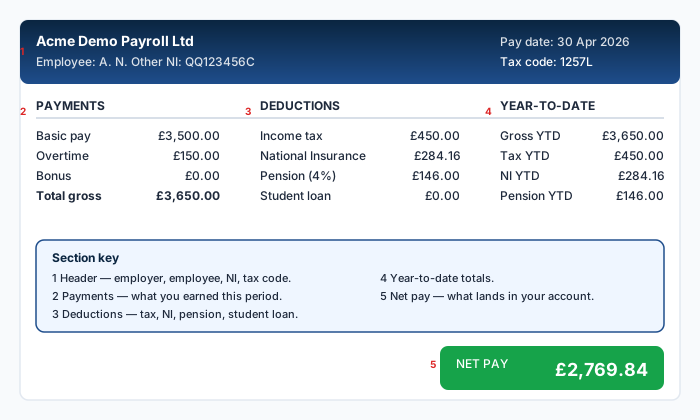
Want to check if your own payslip adds up?
What your employer must include
Under the Employment Rights Act 1996, every UK employer must provide an itemised pay statement. At a minimum, it must show:
- Your gross pay (the total before deductions)
- The amounts and purposes of any fixed deductions
- The amounts and purposes of any variable deductions
- Your net pay (the amount actually paid to you)
- Where your pay is split across methods, the amount and method for each part
Some employers show far more than the legal minimum, which is helpful but can also make the document look overwhelming. The sections below cover what you will typically see.
Gross pay
Gross pay is the total amount you have earned before anything is taken off. For a salaried employee paid monthly, this is usually your annual salary divided by 12. For hourly workers, it is your hourly rate multiplied by the hours worked in the pay period.
If you received overtime, a bonus, or commission during the period, these are normally added to your basic pay to give a higher gross figure. It can be worth checking that the hours or bonus amount matches what you expected.
Worked example
Suppose your annual salary is £30,000. Your monthly gross pay would be:
£30,000 / 12 = £2,500.00
That is the gross figure. The take-home pay on a £30,000 salary is lower again, once tax, National Insurance and pension come out.
If you also worked 10 hours of overtime at £14.42 per hour, your gross for the month would be:
£2,500.00 + £144.20 = £2,644.20
If your gross pay looks different from what you expected, check whether your employer uses a different pay period length. Four-weekly pay, for instance, gives 13 pay periods per year rather than 12.
Deductions: tax, NI, and pension
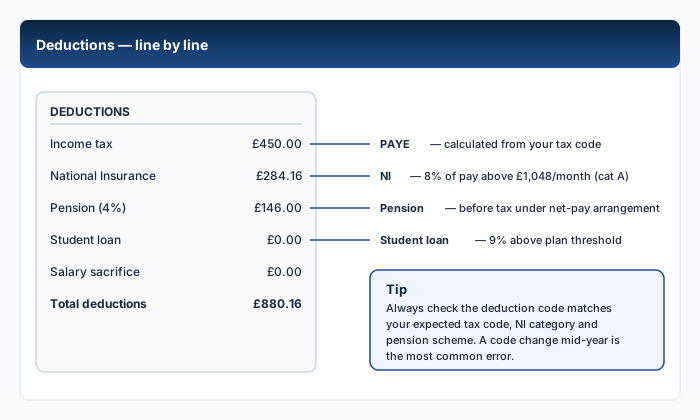
The largest deductions on most payslips are income tax (PAYE), National Insurance contributions (NICs), and workplace pension contributions.
Income tax is calculated using your tax code. The standard code for the current tax year is 1257L, which gives you a Personal Allowance of £12,570. Earnings above that threshold are taxed at 20% (basic rate up to £50,270), 40% (higher rate up to £125,140), or 45% (additional rate above £125,140). For a full explanation, see our guide to the 1257L tax code.
National Insurance for most employees (category A) is charged at 8% on earnings between £12,570 and £50,270 per year, and 2% on earnings above that. Your payslip may show the NI category letter, which determines the exact rates that apply. See our guide to NI category letters for details, or put your own salary through the National Insurance calculator to see what those two rates come to in cash.
Workplace pension contributions under auto-enrolment are a minimum of 5% from the employee and 3% from the employer, based on qualifying earnings. Your payslip should show your contribution; the employer's contribution may appear separately or not at all. The workplace pension calculator works out what the 5% and 3% amount to on your own qualifying earnings.
To check whether those tax, NI and pension lines look right on your own payslip, see How do I check my payslip is correct?.
Year-to-date (YTD) figures
Most payslips include year-to-date totals for gross pay, tax paid, NI paid, and sometimes pension contributions. These running totals start from 6 April each year (the beginning of the UK tax year) and accumulate with each pay period.
YTD figures are useful because they let you cross-check your deductions over time. If your tax code changed mid-year, or you received a one-off bonus, the YTD totals help you see whether the cumulative deductions are on track. For a deeper look, see our guide on YTD on your payslip.
Other deductions and additions
Below the main deductions, you may see additional lines such as:
- Student loan repayments (Plan 1, Plan 2, Plan 4, Plan 5, or Postgraduate Loan) - the student loan repayment calculator carries the threshold and rate for each plan
- Salary sacrifice items (childcare vouchers, cycle-to-work scheme, additional pension)
- Attachment of earnings (court-ordered deductions)
- Union subscriptions
- Give As You Earn charitable donations
Each of these should be clearly labelled. If you see a deduction you do not recognise, it is worth asking your payroll department for clarification.
A common mistake is confusing salary sacrifice deductions with post-tax deductions. Salary sacrifice reduces your gross pay before tax is calculated, so it also reduces your tax and NI. A post-tax deduction comes off after tax. The distinction matters if you are checking whether your tax figure is correct.
Net pay
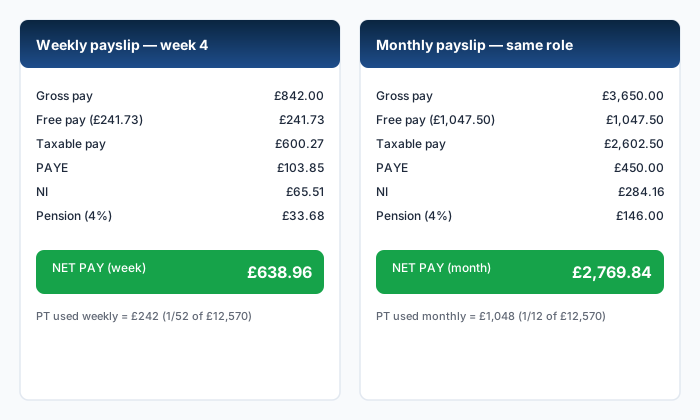
Net pay is the final figure: the amount that lands in your bank account. It should equal your gross pay minus all deductions. If it does not, something on the payslip may be wrong, or there may be a rounding difference of a penny or two.
A quick sanity check: add up every deduction on the payslip and subtract the total from gross pay. The result should match the net pay figure. If there is a gap of more than a few pence, it can be worth querying it.
You can run your figures through our payslip checker to see whether the deductions match current HMRC rates. To work the other way round and start from a salary rather than a payslip, the take-home pay calculator does the same arithmetic in reverse.
Frequently Asked Questions
Is my employer legally required to give me a payslip?
Yes. Under the Employment Rights Act 1996 (as amended in 2019), all workers, including agency workers and those on zero-hours contracts, have the right to an itemised pay statement. Your employer must provide it on or before each pay day.
What should I do if I spot an error on my payslip?
Start by raising it with your employer's payroll department. If the issue relates to your tax code, you can also contact HMRC on 0300 200 3300 or check your tax code online via your Personal Tax Account at GOV.UK.
Why does my payslip show a different tax code from last month?
HMRC can update your tax code at any time during the year, for example if your estimated benefits in kind change or if you owe tax from a previous year. Your employer receives the new code directly from HMRC and applies it from the next pay period. Put the old and the new code through the tax code checker to see what each one is telling payroll to do.
Can I get a replacement payslip if I lose mine?
Your employer is not legally obliged to reissue payslips, but most will provide a duplicate if you ask. If you need the information for a tax query, your P60 (issued after the end of the tax year) summarises the same totals.
How do I check if my tax deduction is correct?
You can use the PayslipIQ payslip checker to compare your deductions against current HMRC rates. Enter your gross pay, tax code, and deductions, and the tool will flag anything that looks unusual.
Sources
Ready to check your own payslip?
Enter your figures and get an instant AI-powered analysis. Free, private, no signup.
Check my payslip freePayslipIQ provides educational information and estimated calculations only. It does not provide tax, legal, financial, payroll, accounting, pension, benefits or employment advice. Always verify your payslip, tax code, deductions and take-home pay with your employer's payroll department, HMRC, your pension provider, a qualified accountant, tax adviser or another appropriately qualified professional.