Your National Insurance category letter, printed on your payslip, tells payroll which employee and employer NI rates to use. Most employees are category A: 8% on earnings between £12,570 and £50,270 a year and 2% above. Other letters cover under-21s, apprentices, people over State Pension age, veterans, deferment and special tax sites.
For most letters your own deduction is the same as category A. What changes is usually the employer's bill. The exceptions that change your own deduction are B (reduced rate), C and S and K (over State Pension age), and J, L, D and Z (deferment). The figures below are HMRC's rates for 6 April 2026 to 5 April 2027 (HMRC).
The figures behind the letters, 2026/27
| Figure | 2026/27 value | In force from | Source |
|---|---|---|---|
| Your own NI on category A, between the thresholds | 8% | 6 April 2024, unchanged since | HMRC |
| Your own NI on category A, above the Upper Earnings Limit | 2% | 6 April 2024, unchanged since | HMRC |
| Reduced rate on categories B, I and E | 1.85% | published rate for 2026/27 | HMRC |
| Primary Threshold, where your own NI starts | £242 a week, £1,048 a month, £12,570 a year | published thresholds for 2026/27 | HMRC |
| Upper Earnings Limit, where your rate drops to 2% | £967 a week, £4,189 a month, £50,270 a year | published thresholds for 2026/27 | HMRC |
| Employer NI above the £5,000 Secondary Threshold | 15% | 6 April 2025, up from 13.8% in 2024/25 | HMRC |
| Letters on which you pay no employee NI at all | C, S, K and X | published rates for 2026/27 | HMRC |
The third column is the date each figure came into force where HMRC publishes one, and the tax year the figure is published for where it does not. It is not the date this page was reviewed. Every figure was re-read at its HMRC source on 27 September 2026.
Want to check if your own payslip adds up?
Every NI category letter for 2026/27
Employee rates apply to earnings between the Primary Threshold (£12,570) and the Upper Earnings Limit (£50,270), then above the Upper Earnings Limit. Employer rates are shown for three bands above the Secondary Threshold (£5,000). All figures are annual equivalents of HMRC's weekly and monthly thresholds (HMRC).
| Letter | Who it applies to | Employee: £12,570 to £50,270 | Employee: above £50,270 | Employer: £5,000 to £25,000 | Employer: £25,000 to £50,270 | Employer: above £50,270 |
|---|---|---|---|---|---|---|
| A | All employees not covered by another letter | 8% | 2% | 15% | 15% | 15% |
| B | Married women and widows with a reduced-rate certificate of election | 1.85% | 2% | 15% | 15% | 15% |
| C | Employees over State Pension age | nil | nil | 15% | 15% | 15% |
| H | Apprentices under 25 | 8% | 2% | 0% | 0% | 15% |
| J | Employees deferring NI because they pay it in another job | 2% | 2% | 15% | 15% | 15% |
| M | Employees under 21 | 8% | 2% | 0% | 0% | 15% |
| V | Veterans in their first civilian job since leaving the armed forces | 8% | 2% | 0% | 0% | 15% |
| Z | Employees under 21 deferring NI | 2% | 2% | 0% | 0% | 15% |
| X | No NI due, for example employees under 16 | none | none | none | none | none |
| F | Freeport special tax site: all employees not in I, L or S | 8% | 2% | 0% | 15% | 15% |
| I | Freeport special tax site: married women and widows on the reduced rate | 1.85% | 2% | 0% | 15% | 15% |
| L | Freeport special tax site: deferment | 2% | 2% | 0% | 15% | 15% |
| S | Freeport special tax site: over State Pension age | nil | nil | 0% | 15% | 15% |
| N | Investment Zone special tax site: all employees not in E, D or K | 8% | 2% | 0% | 15% | 15% |
| E | Investment Zone special tax site: married women and widows on the reduced rate | 1.85% | 2% | 0% | 15% | 15% |
| D | Investment Zone special tax site: deferment | 2% | 2% | 0% | 15% | 15% |
| K | Investment Zone special tax site: over State Pension age | nil | nil | 0% | 15% | 15% |
Sources: HMRC, National Insurance rates and categories and category letters. Nobody pays employee NI on earnings below £12,570, and employers pay nothing below £5,000.
Four cells in this table were corrected on 21 September 2026. The rates shown are the ones HMRC publishes; if you have seen different employee rates for V, Z, L or S on this page before that date, use the table above.
The 2026/27 thresholds behind the letters
| Threshold | Weekly | Monthly | Yearly |
|---|---|---|---|
| Lower Earnings Limit | £129 | £559 | £6,708 |
| Primary Threshold (employee NI starts) | £242 | £1,048 | £12,570 |
| Secondary Threshold, ST (employer NI starts) | £96 | £417 | £5,000 |
| Freeport and Investment Zone Upper Secondary Threshold (FUST) | £481 | £2,083 | £25,000 |
| Upper Secondary Threshold for under-21s (UST, letters M and Z) | £967 | £4,189 | £50,270 |
| Apprentice Upper Secondary Threshold (AUST, letter H) | £967 | £4,189 | £50,270 |
| Veterans Upper Secondary Threshold (VUST, letter V) | £967 | £4,189 | £50,270 |
| Upper Earnings Limit | £967 | £4,189 | £50,270 |
Source: HMRC, Rates and thresholds for employers 2026 to 2027.
Payroll software and HMRC's own tables use the short forms in brackets. ST, UST, AUST and FUST are ceilings on the employer's relief only: above each one the employer pays the standard 15%. Your own deduction ignores all four and follows the Primary Threshold and the Upper Earnings Limit.
How your category is decided
Your employer chooses the letter from HMRC's rules. It depends on:
- Age. Under 21 is M, or Z with deferment. At State Pension age the letter should change to C.
- Apprenticeship. An apprentice under 25 should be on H. The relief ends at whichever comes first, the apprenticeship finishing or the 25th birthday, and the letter should move to A at that point.
- Armed forces service. A veteran's first civilian job since leaving the regular armed forces qualifies for V for 12 months from the first day of that job (HMRC).
- A reduced-rate election. Only married women and widows who hold a certificate of election use B. The election closed to new claimants in 1977, so B now appears on very few payslips: only women who already held the right and have never given it up.
- Deferment. J, Z, L and D are used only when HMRC has agreed that you can defer NI on one job (HMRC).
- Where you work. F, I, L and S apply only where the employer expects you to spend at least 60% of your working time at a Freeport special tax site, for the first 36 months of your employment. N, E, D and K follow the same rule for Investment Zone special tax sites (HMRC). Working near a site is not enough; the employment itself has to qualify at a registered one.
Worked examples for 2026/27
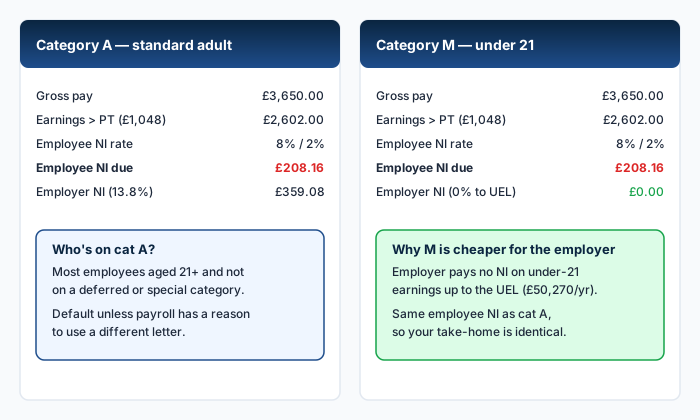
Category M: a 19-year-old on £30,000
- Employee NI: (£30,000 − £12,570) × 8% = £1,394.40 a year, the same as category A.
- Employer NI on category M: £0, because all of the pay is below the £50,270 Upper Secondary Threshold.
- Employer NI if payroll wrongly used category A: (£30,000 − £5,000) × 15% = £3,750.
The letter does not change the employee's take-home pay. It changes the employer's cost by £3,750 a year.
Category C: a 67-year-old on £2,500 a month
- Employee NI: £0.00.
- Employer NI: (£2,500 − £417) × 15% = £312.45 a month.
If payroll leaves this employee on category A by mistake, they would lose (£2,500 − £1,048) × 8% = £116.16 a month. That is refundable, so raise it straight away.
If you reach State Pension age part-way through a pay period, your employer can either run category A up to the birthday and C for the rest of that period, or switch to C from the start of the next one. HMRC accepts either, so one month of employee NI spanning the birthday is not automatically wrong. A second month of it is.
Category V: a veteran on £45,000
- Employee NI: (£45,000 − £12,570) × 8% = £2,594.40, the same as category A.
- Employer NI: £0 for the first 12 months of the job, because the pay is below the £50,270 Veterans Upper Secondary Threshold. On category A it would be (£45,000 − £5,000) × 15% = £6,000.
Category J: deferment with two jobs
You can only defer if HMRC agrees. For 2026/27 you normally need to earn at least £967 a week in one job and at least £242 a week in the second. If HMRC agrees, the second job deducts 2% instead of 8% on earnings between £242 and £967 a week, and HMRC checks at the end of the year whether you paid enough. Apply on form CA72A; HMRC must receive it by 14 February 2027 (HMRC).
Take a main job paying £45,000 on category A and a second paying £15,000 on category J:
- Main job: (£45,000 − £12,570) × 8% = £2,594.40 a year.
- Second job on J: 2% of the £2,430 above £12,570, so about £49 a year.
- Second job on A instead: (£15,000 − £12,570) × 8% = £194.40 a year.
Deferment is a cash-flow arrangement, not a discount. HMRC reconciles both jobs after 5 April and asks for anything short, so the 2% rate on the second job does not settle the bill on its own.
Two jobs, two letters
Each employment carries exactly one category letter in any pay period. One job cannot hold two letters at once, but two jobs can hold different ones: A in the main job and J in the second, or M in one and Z in the other. Each employer sets its own letter from its own record of your circumstances, which is why a change of status has to be told to both.
Paying Class 1 NI in two jobs at the same time can also take you past the annual maximum contribution for the year. Where it does, the excess is refundable: apply to HMRC on form CA5610 and HMRC works the position out across every employment. If several jobs overlap and the sums are large, an adviser can check whether you are over the maximum before you apply.
Red flags on your payslip
- NI still deducted after State Pension age. Your letter should change to C and your employee NI should fall to £0. You may need to show proof of age.
- Category X when you are aged 16 or over and earn above £242 a week. X means no NI is due at all. For most working adults that is wrong, and you should ask payroll why it has been used. The usual cause is a starter declaration that was never processed properly when you joined.
- Reading the tax code letter as the NI letter. The letter in a tax code (L, M, K, BR and the rest) and the NI category letter are separate systems doing different jobs. A change to one tells you nothing about the other.
- An apprentice under 25 on A instead of H, or an under-21 on A instead of M. Your own deduction is the same, but your employer is paying NI it does not owe. It is still worth raising: the relief is not applied retrospectively on its own, and putting it right after the event takes an RTI amendment from the employer.
- J, Z, L or D without a deferment agreement from HMRC. You would pay too little NI and owe the difference later.
- A missed birthday, or a missed job change. At 21 the letter should move from M to A (or Z to J). At 25 an apprentice moves from H to A. A new employer is the other common trigger: a starter's letter is often carried over from an out-of-date HR record instead of being set from their circumstances on the day they joined.
Checking and correcting your category letter
- Find the letter next to the NI deduction on your payslip.
- Compare it with the table above and with your age, apprenticeship, veteran status and any deferment.
- Check what your employer is actually reporting. Your HMRC personal tax account shows the category submitted through RTI, and that is the record HMRC works from.
- Ask payroll to correct it, in writing. Name the letter you think applies and the date it should apply from. Only your employer can change it.
- Have the evidence ready: proof of age, the apprenticeship agreement, your discharge papers or veteran ID, or the CA2700 certificate HMRC issues once it has agreed deferment.
- Check that the next payslip shows the new letter and the right deduction, and keep the payslips from either side of the correction.
- If NI was over-deducted and your employer cannot put it right, contact HMRC on 0300 200 3500 (HMRC) or use HMRC's NI refund checker.
A correction made inside the same tax year runs through PAYE and returns any over-deduction on the next pay run. After 5 April, HMRC reconciles the year instead and may issue a P800, which is slower, so it is worth pressing payroll before the year closes. Under-payments usually have to be put right too, because they affect your National Insurance record.
Frequently asked questions
What is the most common NI category?
Category A. It applies to all employees who do not fall into another group, which in practice means most employees aged 21 to State Pension age who are not apprentices under 25, veterans in their first civilian job, deferring NI or working at a special tax site.
What does NI category M mean?
Category M is for employees under 21. You pay the same employee National Insurance as category A, 8% between £12,570 and £50,270 and 2% above. Your employer pays no employer National Insurance on your earnings up to £50,270.
Does my NI category affect my State Pension?
Your National Insurance record, built from the contributions you pay before State Pension age, decides your State Pension, so a wrong letter can mean the wrong contributions are recorded. Once you reach State Pension age you move to category C and pay no employee National Insurance.
Can I choose my NI category?
No. Your employer assigns it from HMRC's rules, based on your age, whether you are an apprentice under 25, whether you are a veteran in your first civilian job, whether HMRC has agreed that you can defer, and where you work. If your circumstances have changed and your letter has not, raise it with payroll.
Can I be on two NI categories at once?
Not in the same job. Each employment carries one letter for each pay period. Two jobs can carry different letters, so being on A in your main job and J in a second job is normal rather than an error.
Can I get National Insurance back if I have paid it in two jobs?
Possibly. Class 1 contributions have an annual maximum for the year, and paying in two jobs at the same time can take you past it. Apply to HMRC on form CA5610 and HMRC works out your position across every employment.
What happens when I turn 21?
Your employer should move you from category M to category A, or from Z to J if you defer. Your own deduction stays the same, 8% and 2%, but your employer starts paying employer National Insurance above £5,000.
I am a veteran. How do I get category V?
Tell your employer that this is your first civilian job since leaving the regular armed forces. Your employer can then use category V for the first 12 months of the job. Your own National Insurance is unchanged; your employer pays no employer NI on your earnings up to £50,270.
What does NI category X mean?
Category X means no National Insurance is due on the job, for example because the employee is under 16. If you are 16 or over and earn above £242 a week, category X is unlikely to be right.
Sources
All sources were opened and checked by PayslipIQ on 21 September 2026. Consolidated on 24 September 2026: three earlier PayslipIQ pages answered the same question and now redirect here, and anything they carried that is not already above has been merged in.
- HMRC (GOV.UK): National Insurance rates and categories: contribution rates. Employee and employer rates for every letter from 6 April 2026. Verified 21 Sep 2026.
- HMRC (GOV.UK): National Insurance category letters. Who each letter applies to, including Freeport, Investment Zone and X. Verified 21 Sep 2026.
- HMRC (GOV.UK): Rates and thresholds for employers 2026 to 2027. All thresholds and category rates. Verified 21 Sep 2026.
- HMRC (GOV.UK): Defer your National Insurance. Qualifying earnings, the 2% rate and the 14 February 2027 deadline. Verified 21 Sep 2026.
- HMRC (GOV.UK): Claim National Insurance contributions relief for veterans as an employer. The 12-month qualifying period. Verified 21 Sep 2026.
- HMRC (GOV.UK): Check if you can claim National Insurance relief in Freeport or Investment Zone special tax sites. The 60% and 36-month rules. Verified 21 Sep 2026.
- HMRC (GOV.UK): National Insurance: enquiries. Helpline 0300 200 3500. Verified 21 Sep 2026.
Ready to check your own payslip?
Enter your figures and get an instant AI-powered analysis. Free, private, no signup.
Check my payslip freePayslipIQ provides educational information and estimated calculations only. It does not provide tax, legal, financial, payroll, accounting, pension, benefits or employment advice. Always verify your payslip, tax code, deductions and take-home pay with your employer's payroll department, HMRC, your pension provider, a qualified accountant, tax adviser or another appropriately qualified professional.