Your payslip, P60, and P45 are three different documents that record your pay and tax information. Each serves a distinct purpose, and understanding the differences helps you manage your tax affairs and respond to requests from lenders, HMRC, or new employers.
To check whether the tax, NI and PAYE lines look right on your own slip, see How do I check my payslip is correct?.
Want to check if your own payslip adds up?
Your payslip
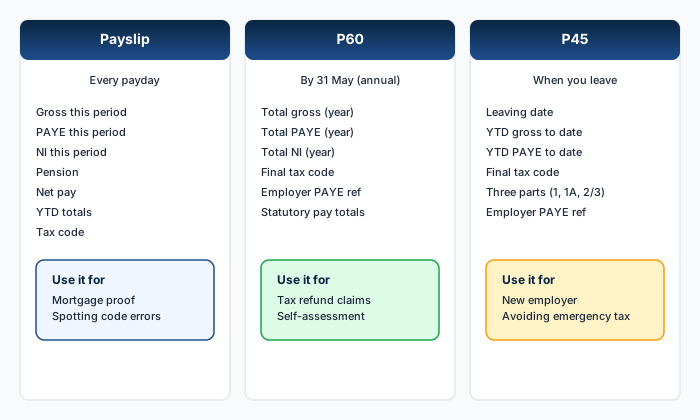
A payslip is issued every time you are paid: weekly, fortnightly, or monthly. It shows the breakdown for that single pay period plus year-to-date (YTD) cumulative totals.
Key information on a payslip:
- Gross pay for the period
- Income tax deducted
- National Insurance deducted
- Pension contributions
- Student loan repayments (if applicable)
- Net pay (take-home pay)
- Tax code and NI category letter
- YTD totals for gross pay, tax, and NI
Your employer is legally required to provide a payslip on or before each pay date. It can be paper or electronic.
Your P60
A P60 is an end-of-year summary. Your employer issues it after the tax year ends on 5 April, and you should receive it by 31 May. It covers the entire tax year and shows:
- Your total gross pay for the year
- Total income tax deducted
- Total National Insurance contributions
- Your tax code at the end of the year
- Your employer's name and PAYE reference
The P60 is the definitive record of your earnings and tax for the year. You need it for Self Assessment tax returns, mortgage applications, and tax refund claims. Your employer is required to provide one to every employee who is on the payroll on 5 April.
Checking your P60 against your payslips
The figures on your P60 should match the YTD totals on your final payslip of the tax year. If they differ, raise it with your payroll department promptly, as incorrect P60 figures can cause problems with HMRC.
Keep your P60 safe. Your employer is not required to issue a replacement if you lose it, though many will provide a duplicate on request. You may need the P60 for several years for tax or financial purposes.
Your P45
A P45 is issued when you leave a job. It contains four parts: Part 1 goes to HMRC, Part 1A is for your records, and Parts 2 and 3 go to your new employer. The P45 shows:
- Your tax code at the date of leaving
- Your total gross pay and tax paid from 6 April to your leaving date
- Your employer's name and PAYE reference
- Your National Insurance number
Your new employer uses the P45 to set up your tax correctly from day one. Without it, they may have to apply an emergency tax code, which can result in overpayment of tax. For more on this, see our guide on emergency tax codes.
When you need each document
| Document | When issued | When you need it |
|---|---|---|
| Payslip | Every pay period | Checking monthly deductions, budgeting, mortgage evidence |
| P60 | After 5 April each year | Self Assessment, tax refund claims, mortgage applications |
| P45 | When you leave a job | Starting a new job, claiming benefits, tax refund claims |
If you start a new job and cannot provide a P45 (for example, because your previous employer has not yet issued one), your new employer should give you a starter checklist to complete. This helps them apply a reasonable tax code, but it may still result in an emergency code until HMRC confirms your details.
What if you do not receive one of these documents?
- Payslip: your employer is legally required to provide one. If they do not, raise it with them in writing. If they still refuse, you can contact Acas or make a complaint to an employment tribunal.
- P60: must be provided by 31 May after the end of the tax year. If you do not receive one, ask your employer.
- P45: your employer must issue this when you leave. If they do not, contact HMRC, who can provide the information to your new employer directly.
Frequently Asked Questions
Can I use payslips instead of a P60 for my tax return?
HMRC prefers the P60, as it is the official end-of-year summary. However, if you do not have a P60, you can use your final payslip of the tax year (with YTD figures) as a reference. You should still try to obtain the P60 from your employer.
Do I get a P45 if I am made redundant?
Yes. Your employer must issue a P45 regardless of the reason you leave, whether you resign, are made redundant, or are dismissed.
What if I have lost my P45 before starting a new job?
Your previous employer is not required to issue a duplicate P45. Complete a starter checklist for your new employer instead. HMRC will eventually send the correct tax code to your new employer, and any overpaid tax will be refunded.
Is a P60 the same as a tax return?
No. A P60 summarises your PAYE earnings and deductions. A tax return (Self Assessment) covers all your income, including self-employment, rental income, and investment income. You may use your P60 as a source document when completing your tax return.
How long should I keep these documents?
Keep payslips for at least 22 months (to cover the current and previous tax year). Keep P60s for at least six years, as HMRC can enquire into your tax affairs going back that far.
Sources
Ready to check your own payslip?
Enter your figures and get an instant AI-powered analysis. Free, private, no signup.
Check my payslip freePayslipIQ provides educational information and estimated calculations only. It does not provide tax, legal, financial, payroll, accounting, pension, benefits or employment advice. Always verify your payslip, tax code, deductions and take-home pay with your employer's payroll department, HMRC, your pension provider, a qualified accountant, tax adviser or another appropriately qualified professional.