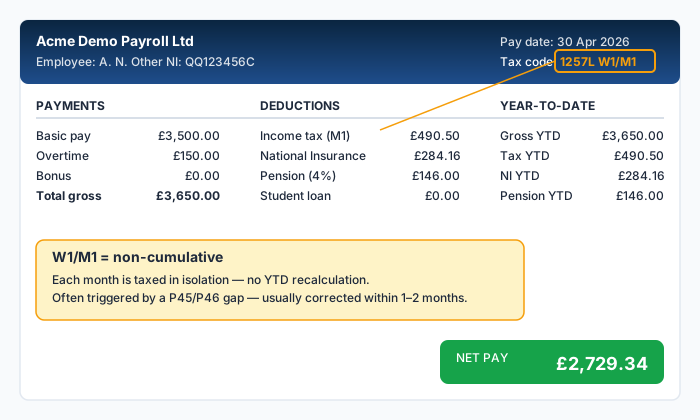
An emergency tax code is not a different tax code. It is your ordinary code with the cumulative calculation switched off. The letters W1, M1 or X on the end tell your employer to work this pay period out on its own, as if you were paid that amount every week or month of the year, and to ignore everything that happened earlier in the tax year (GOV.UK).
That is the whole mechanism, and it decides everything else - including whether the emergency basis is costing you anything at all. Sometimes it costs nothing. Sometimes it costs a few hundred pounds in one month. This guide shows you which of those is happening on your payslip, using figures you can check against the slip in front of you.
To check whether the tax-code, tax and NI lines look right on your own slip, see How do I check my payslip is correct?.
What the emergency basis uses, 2026/27
| Figure | 2026/27 value | In force from | Source |
|---|---|---|---|
| The emergency code | 1257L | 6 April 2026 | HMRC P9X |
| Non-cumulative markers you may see | W1, M1, X, or NONCUM on some payslips | unchanged | GOV.UK |
| Free pay a 1257L code gives, per month | £12,570 a year, so £1,047.50 a month | 6 April 2026 | HMRC P9X |
| PAYE starting point | £242 a week, £1,048 a month | 6 April 2026 | HMRC P9X |
| How long HMRC takes to issue the right code | "up to 35 days from when you start your job" | unchanged | GOV.UK |
| When to chase it | by your next pay day if monthly, your third if weekly | unchanged | GOV.UK |
The third column is the date each figure came into force. The suffix, not the number, is what makes a code an emergency code.
Want to check if your own payslip adds up?
The two-line test: am I actually on it?
Look at the tax-code box on your payslip. If it ends in W1, M1 or X you are on the non-cumulative basis. Payroll software does not always print it that way - GOV.UK notes you may see NONCUM instead (GOV.UK) - so there is a second check that works whatever the box says.
Take this period's taxable pay and this period's tax, and nothing else:
- Monthly, code 1257L: if
(taxable pay − £1,047.50) × 20%equals the tax deducted, and you did not start this job in April, you are almost certainly on M1. - Weekly: the same test, using one fifty-second of your code's free pay in place of £1,047.50.
On a cumulative code the figures will not line up like that except by coincidence, because a cumulative calculation looks at your pay and tax to date, not at this period alone.
Worked check. Monthly gross £3,000.00 on 1257L M1: £3,000.00 − £1,047.50 = £1,952.50 of taxable pay, and £1,952.50 × 20% = £390.50 of tax. If your slip says £390.50, the test has passed.
The number is not the emergency part
The emergency code for 2026/27 is 1257L (HMRC P9X), but the W1/M1/X marker can sit on any code at all. GOV.UK's own examples are 1257L W1, S875L M1 and C663L X (GOV.UK).
That matters because the number in front of the letter is what sets your free pay, and it is not always 1257. A code of S875L gives £8,750 a year of free pay, which is £729.17 a month. C663L gives £6,630, which is £552.50 a month. If you read "the emergency code is 1257L", then try to reconcile a payslip that says something else, the arithmetic will never work. Divide your code's number by 10 for the annual free pay, then by 12 or 52 for the period.
The S is a Scottish taxpayer, the C a Welsh one. Neither changes how the emergency basis works.
When the emergency basis costs you nothing
This is the part no rate table tells you, and it decides whether there is anything to chase.
Over a full year, cumulative and non-cumulative give you exactly the same personal allowance: one twelfth of it each month, or one fifty-second each week. The two diverge in only two situations - when you have allowance you have not used, and when your pay is uneven enough for one period to reach into a higher rate that your yearly income never reaches.
So:
- You have been paid at a level rate since April. The emergency basis is charging you the same tax the cumulative code would. There is nothing to reclaim. The code should still be corrected, because the difference will appear the moment your pay changes.
- You started mid-year after a gap. The emergency basis is ignoring the unused allowance from those months. This is the overpayment case.
- Your pay is uneven. The emergency basis can charge you at the higher rate in a single big month. This is the case that catches people out at bonus time, and it is not a refund that lands next month.
Case 1 - starting in September after time out of work
You start a new job in month 6 of the tax year on £3,000 a month, with no pay from any employer since April.
| Emergency, 1257L M1 | Cumulative, 1257L | |
|---|---|---|
| Free pay this month | £1,047.50 | £6,285.00, being six months' worth |
| Taxable pay this month | £1,952.50 | nil |
| Tax deducted | £390.50 | £0.00 |
The cumulative column works like this: free pay to date in month 6 is £6,285.00, your pay to date is £3,000.00, so there is no taxable pay to date and no tax due yet.
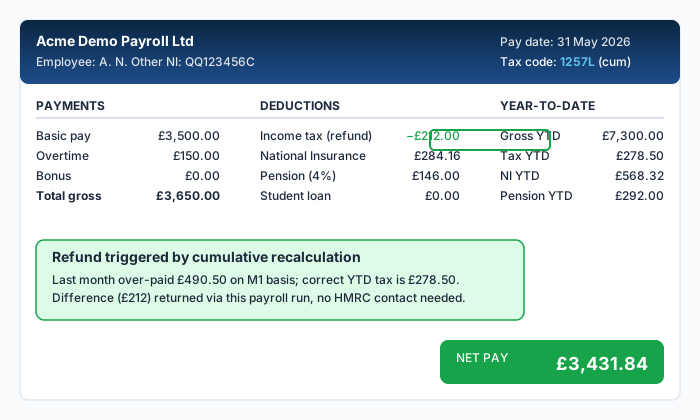
When the cumulative code arrives - say for month 7 - your employer recalculates from 6 April. Pay to date is £6,000.00 against free pay to date of £7,332.50, so the tax due for the year so far is still nil, and the £390.50 already deducted comes back as a refund in that month's pay. You do not have to claim it.
Case 2 - a bonus month while still on M1
You earn £3,000 a month and receive a £3,000 bonus in month 6. Your pay for the year will be £39,000, which is entirely within the basic rate.
On 1257L M1, that month is taxed as though £6,000 were your every month:
- Taxable pay: £6,000.00 − £1,047.50 = £4,952.50
- One twelfth of the £37,700 basic-rate band is £3,141.67, so £4,952.50 − £3,141.67 = £1,810.83 is charged at 40%
- PAYE for the month: £1,352.67
On the cumulative code, the same month costs far less, because the calculation can see the whole year to date:
- Pay to date £21,000.00, free pay to date £6,285.00, so taxable to date is £21,000.00 − £6,285.00 = £14,715.00
- Tax due to date: £14,715.00 × 20% = £2,943.00
- Tax deducted in months 1 to 5 came to £1,952.50 - the same figure on either basis, because the pay was level - so this month's tax is £2,943.00 − £1,952.50 = £990.50
£1,352.67 − £990.50 = £362.17 more tax, in one month, purely from the code being non-cumulative. Nothing about the bonus is taxed at 40% over the year: the correct annual bill on £39,000 is £5,286.00, all of it at the basic rate.
The £362.17 is not refunded next month unless the code is made cumulative. If W1/M1/X is still on your code at 5 April, the correction happens at HMRC's year-end reconciliation and arrives as a P800 letter, months later. A bonus is therefore the point at which chasing a stale emergency code stops being tidy-up and starts being worth real money.
Who can actually fix it - and it is usually not payroll
The order of events matters more than most guides admit.
Before your first pay run, your employer works out a code from your P45 or, if you do not have one, from the starter checklist you complete. Getting a P45 to payroll before the first Full Payment Submission is the one moment when handing over paperwork changes the code directly.
After your first pay run, that window has closed. HMRC's instruction to employers is to "keep using the tax code you used in your first Full Payment Submission (FPS) until HMRC sends you a new one" (GOV.UK). Your employer is not being obstructive when they say they cannot change it. They are following the rule.
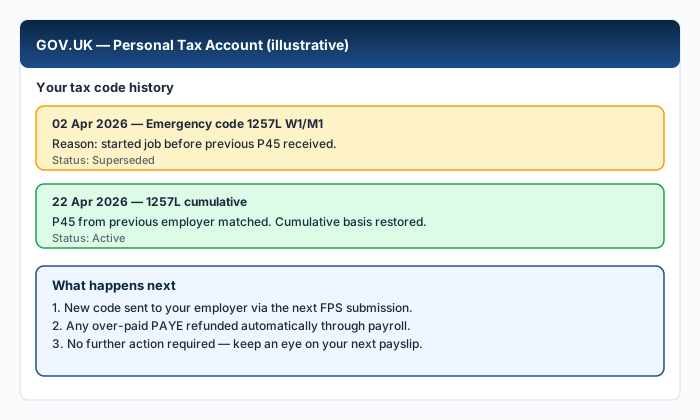
So once you have been paid once, the lever is HMRC, not payroll:
- Sign in to your Personal Tax Account and check your employment record. Look for a job you have left that still shows as open: while HMRC believes you hold two live employments it splits your allowance between them, and ending the ceased one in the account is often the whole fix.
- Check your estimated pay for the year on the same screen. An estimate carried over from a higher-paid job will keep your code wrong even after the emergency marker goes.
- Call HMRC on 0300 200 3300 if the account will not let you correct it. Have your National Insurance number and your employer's PAYE reference - the reference is on your payslip.
- Tell payroll only after HMRC has issued the code. They apply it on the first pay run after they receive it.
When to start chasing
GOV.UK sets two markers. HMRC expects to have your code to your employer within 35 days of you starting (GOV.UK), and separately says to speak to your employer if the change has not been applied by your next pay day if you are paid monthly, or your third if you are paid weekly (GOV.UK).
Those are the dates to use. Before them, nothing has gone wrong. After them, something has.
BR and 0T are not emergency codes
They are often described as emergency codes and they are not the same thing. The emergency basis is the W1/M1/X marker. BR and 0T are codes that give you no personal allowance at all, and GOV.UK explains that they usually mean the starter checklist was not completed, or was completed incorrectly (GOV.UK).
The difference is worth knowing because the arithmetic and the fix are different:
| Code | Free pay | Taxed how | Typical cause |
|---|---|---|---|
| 1257L W1 / M1 / X | £1,047.50 a month | this period only, at the normal bands | new job, HMRC has not yet issued a code |
| BR | none | every pound at 20% | a second job or pension, or Statement C on the checklist |
| 0T | none | every pound, at 20%, then 40%, then 45% | no checklist completed, or your allowance is genuinely used up |
If your code is BR or 0T, start with BR and 0T compared and tax code 0T explained, because there the overpayment is usually larger and the cause is a form rather than a delay.
National Insurance is untouched
Your NI is worked out from this period's pay against the published period thresholds - £1,048 a month, £242 a week for 2026/27 (HMRC P9X) - and your tax code is not part of that calculation.
So NI is always non-cumulative, for everyone, all year. If your NI line looks wrong, the emergency code is not the reason.
Frequently Asked Questions
How do I know if I am on an emergency tax code?
Look for W1, M1, X or NONCUM after the code on your payslip. If the suffix is not printed, run the two-line test above: on a monthly 1257L, check whether this period's tax equals (taxable pay − £1,047.50) × 20%.
How long does emergency tax last?
HMRC says it can take up to 35 days from starting your job for the correct code to reach your employer. If your code has not changed by your next pay day when you are paid monthly, or your third when you are paid weekly, GOV.UK's advice is to raise it.
Will I automatically get a refund?
If the code becomes cumulative within the same tax year, yes - your employer recalculates from 6 April and the overpayment comes back through your pay. If W1/M1/X is still on your code when the year ends, it does not: HMRC reconciles after 5 April and sends a P800.
Can I be put on emergency tax if I have not changed jobs?
Yes. GOV.UK lists starting to receive company benefits or the State Pension as triggers as well as starting a job. Anything that makes HMRC recalculate your code can put the non-cumulative marker on it while the new figures settle.
Does emergency tax affect my National Insurance?
No. NI is calculated on each pay period against the published thresholds, independently of your tax code. It is the same on an emergency code as on a cumulative one.
Sources
Ready to check your own payslip?
Enter your figures and get an instant AI-powered analysis. Free, private, no signup.
Check my payslip freePayslipIQ provides educational information and estimated calculations only. It does not provide tax, legal, financial, payroll, accounting, pension, benefits or employment advice. Always verify your payslip, tax code, deductions and take-home pay with your employer's payroll department, HMRC, your pension provider, a qualified accountant, tax adviser or another appropriately qualified professional.