If your tax code is wrong, you could be paying too much or too little tax every month. It can be corrected, and any overpayment is refundable. This guide explains how to spot an incorrect code, what causes the most common errors, and the exact steps to get it fixed.
To check whether the tax, NI and PAYE lines look right on your own slip, see How do I check my payslip is correct?.
Want to check if your own payslip adds up?
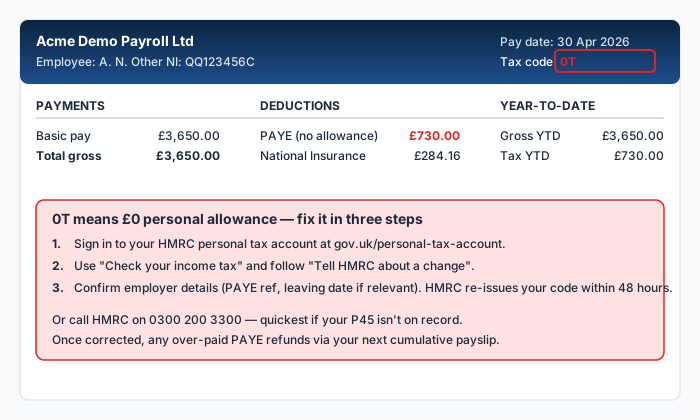
How to check if your tax code is wrong
Your tax code appears on every payslip, usually near the top. The standard code for most employees with one job and no taxable benefits is 1257L, which gives you the full Personal Allowance of £12,570.
To check whether your code is correct:
- Log in to your Personal Tax Account on GOV.UK
- Select "Check your Income Tax" to see your current code
- Review the breakdown: it shows your Personal Allowance and any adjustments HMRC has made
- Compare the adjustments with your actual circumstances
If the breakdown includes items that do not apply to you (for example, a company car you no longer have, or estimated income from a second job you have left), the code is likely wrong.
Quick sense-check
If you have one job, no taxable benefits, and no outstanding tax debts, your code should be 1257L. If it is anything else, it is worth investigating.
HMRC sends a coding notice (form P2) whenever your tax code changes. This document explains the calculation behind your code. If you have not received one recently, you can view the equivalent information through your Personal Tax Account online.
Common reasons for an incorrect tax code
The most frequent causes of a wrong tax code are:
- Outdated benefit in kind records: HMRC may still be accounting for a company car, private medical insurance, or other benefit that has ended
- Estimated income from a second job: if you left a second job but HMRC has not been informed, they may still be adjusting your code for the estimated income
- Underpaid tax from a previous year: HMRC sometimes collects this by reducing your Personal Allowance, which lowers your tax code number
- Marriage Allowance errors: if you or your partner transferred part of the Personal Allowance and your circumstances have changed, the code may not have been updated
- Employer reporting errors: incorrect P11D submissions can lead to wrong benefit values in your code
How to get your tax code corrected
There are three ways to request a correction:
-
Online via your Personal Tax Account: log in at GOV.UK, go to "Check your Income Tax," and update any incorrect information. HMRC will recalculate your code and send a new one to your employer.
-
By phone: call the Income Tax helpline on 0300 200 3300 (Monday to Friday, 8am to 6pm). Have your National Insurance number and employer's PAYE reference ready.
-
By post: write to HMRC at Pay As You Earn and Self Assessment, HM Revenue and Customs, BX9 1AS. Include your National Insurance number, the incorrect code, and an explanation of what is wrong.
The online route is usually the fastest. HMRC typically issues a new code within a few days of an online update. Your employer should apply the new code from the date specified by HMRC.
Do not ask your employer to change your tax code directly. Only HMRC can issue tax codes. Your employer is legally required to use the code HMRC provides. If you believe the code is wrong, the correction must come from HMRC.
What happens after the code is corrected
Once your employer receives the new code from HMRC, they will recalculate your tax on a cumulative basis from 6 April. If you have overpaid, the excess will be refunded through your next payslip (or spread over the remaining pay periods). If you have underpaid, additional tax will be collected, but HMRC usually spreads this over the remaining months to avoid a large one-off deduction.
For more on how refunds appear on your payslip, see our guide on tax refunds from your payslip.
What if the wrong code spans a previous tax year?
If your tax code was wrong for an entire previous tax year, HMRC will issue a P800 tax calculation after the year ends. This will show whether you overpaid or underpaid. Overpayments are refunded; underpayments are usually collected by adjusting your tax code for the following year.
You can claim a refund for overpaid tax going back up to four years. Contact HMRC with your P60 for the relevant year and an explanation of the error.
Frequently Asked Questions
How long does it take HMRC to correct a tax code?
If you update your details online, HMRC typically issues a new code within a few working days. Your employer should apply it from the next pay period after they receive it.
Can a wrong tax code mean I owe HMRC money?
Yes. If your code gave you too much Personal Allowance (resulting in too little tax being deducted), you will owe the difference. HMRC usually collects this by adjusting your code for the following year rather than sending a bill.
Will I be penalised for having the wrong tax code?
No. Tax code errors are not your fault, and HMRC does not charge penalties for them. You are only required to pay the correct amount of tax, and any over- or underpayment is adjusted accordingly.
My employer says my tax code is correct but I disagree. What should I do?
Your employer must use the code HMRC provides. If you believe it is wrong, contact HMRC directly. Your employer cannot change the code on their own authority.
Can I check my tax code without logging in to GOV.UK?
Your tax code appears on your payslip and on any coding notice (form P2) HMRC has sent you. However, to see the full breakdown of how the code was calculated, you need to use your Personal Tax Account online.
Sources
Ready to check your own payslip?
Enter your figures and get an instant AI-powered analysis. Free, private, no signup.
Check my payslip freePayslipIQ provides educational information and estimated calculations only. It does not provide tax, legal, financial, payroll, accounting, pension, benefits or employment advice. Always verify your payslip, tax code, deductions and take-home pay with your employer's payroll department, HMRC, your pension provider, a qualified accountant, tax adviser or another appropriately qualified professional.