Statutory Sick Pay (SSP) is the legal minimum sickness pay your employer must pay if you are off work sick for at least one full working day. The rate, the eligibility rules and the way SSP shows up on a payslip can all be confusing - especially when SSP runs out and you need to switch to Universal Credit. This guide is up to date for the 2026/27 tax year.
To check whether the tax, NI and PAYE lines look right on your own slip, see How do I check my payslip is correct?.
Want to check if your own payslip adds up?
How much is SSP in 2026/27?
The SSP rate is set each April. For 2026/27 the rate is £123.25 per week, or 80% of your average weekly earnings if that is lower (HMRC, Rates and thresholds for employers 2026 to 2027).
| SSP at a glance | 2026/27 |
|---|---|
| Weekly rate | £123.25, or 80% of average weekly earnings if that is lower |
| Maximum duration | 28 weeks in any single period of sickness |
| Paid from | The first qualifying day - the three waiting days were abolished from April 2026 |
| Days it is paid for | Qualifying days only, meaning the days you would normally work |
| Tax and NI | Deducted as usual |
| Paid by | Your employer |
There is no "earnings replacement" calculation - SSP is a flat rate regardless of whether your normal salary is £20,000 or £200,000.
From April 2026: removal of the waiting days
The Employment Rights Act 2025 removed the three-day waiting period and the Lower Earnings Limit qualifying threshold for SSP from April 2026. All employees now receive SSP from the first qualifying day, with no minimum earnings requirement, capped at £123.25 a week or 80% of average weekly earnings, whichever is lower.
Who qualifies?
To be paid SSP in 2026/27 you must (GOV.UK):
- Be classed as an employee (not self-employed)
- Have done some work for your employer
- Have been ill for at least one full working day
- Notify your employer within their stated reporting deadline (7 days if they have not set one)
There is no longer a four-day waiting rule and no minimum earnings test. Both were removed from April 2026, so the two things that used to disqualify a short absence or a low-paid worker no longer do. Agency workers and zero-hours workers qualify on the same three conditions as anyone else - read our agency worker guide.
Self-certification and fit notes
For absences up to 7 days, you can self-certify using the SC2 form. Beyond 7 days, you need a fit note (formerly "sick note") from a doctor, nurse or other healthcare professional. Some employers accept private fit notes; others require NHS notes only.
How SSP appears on your payslip
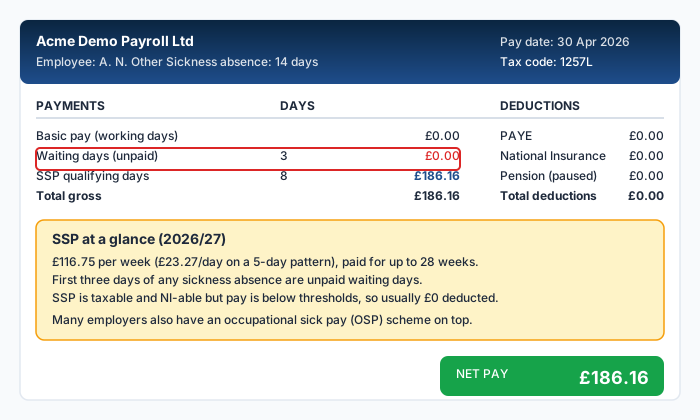
Look for a separate "SSP" line on the gross pay section. Below that you should see normal income tax, NI and other deductions calculated against the reduced gross.
If you have an Occupational Sick Pay (OSP) policy, you may see two lines:
- "SSP" at the statutory rate
- "Company sick pay" or "OSP" topping up to your normal salary or a percentage of it
Both are taxable and NIable in the usual way.
Worked example: a fortnight off sick (2026/27)
You earn £36,000 per year (£3,000 a month) on tax code 1257L. You are off sick for 14 calendar days (10 working days). Your employer offers no occupational sick pay.
- Normal monthly gross: £3,000.00
- Days off paid as SSP: 10 (after April 2026 day-one reform)
- SSP per week: £123.25
- SSP for two weeks: 2 × £123.25 = £246.50
- Days at normal pay (rest of the month): 12 working days x £138.46 (daily rate) = £1,661.54
- Total monthly gross: £246.50 + £1,661.54 = £1,908.04
- Tax (20% of £1,908.04 less the £1,047.50 monthly allowance): £172.11, against £390.50 in a normal month
- NI (8% of £1,908.04 less the £1,048.00 monthly Primary Threshold): £68.80, against £156.16 in a normal month
Net pay is £1,667.13 against the usual £2,453.34 - a £786.21 hit for the fortnight. Tax and NI absorb about a third of the loss; the rest lands on you.
SSP is taxable and NIable. Some people assume it is tax-free because it is statutory - it is not. How much of it survives depends on what else you are paid in the period. If SSP is your only pay that week it arrives whole, because £123.25 is below both the weekly PAYE allowance of £241.73 and the £242 National Insurance threshold. If it sits on top of normal pay that already clears both, a basic-rate taxpayer keeps £88.74 of it - 20% tax and 8% NI come off the lot.
When does SSP stop?
SSP runs for a maximum of 28 weeks for any single Period of Incapacity for Work (PIW). Two or more absences within 8 weeks of each other count as one PIW (the "linking rule").
Once 28 weeks expires:
- Your employer must give you an SSP1 form
- The form helps you claim Universal Credit, ESA, or Personal Independence Payment
- Some employers continue OSP beyond 28 weeks - check your contract
If you go back to work briefly (for example one day) and then become ill again within 8 weeks, the previous SSP days count towards the 28-week total.
What happens after the 28 weeks?
You may qualify for one of:
- New Style ESA (contribution-based) if your NI record is sufficient
- Universal Credit if your household needs financial support
- PIP if your condition has long-term effects on daily living
The SSP1 form is the trigger, and the deadlines on it belong to your employer rather than to you. If your SSP is ending, they must send you form SSP1 within 7 days of it ending where it ends unexpectedly while you are still sick, or on or before the beginning of the 23rd week where the end is expected before your sickness is. If you never qualified, they must send it within 7 days of your first day off sick (GOV.UK).
The form itself says "this form is not an application for benefit" - you use it to support a Universal Credit or New Style ESA claim, and you make that claim directly. There is no separate deadline for sending SSP1 to DWP, so treat the date you claim the benefit as the date that matters and claim as soon as you can.
Many people miss the SSP1 form because they assume the employer will hand it over automatically. Ask for it the moment you know SSP is about to end. Late submission can delay benefits by weeks.
Occupational Sick Pay vs SSP
OSP (also called Company Sick Pay) is anything more than SSP that your employer provides under their own policy. Common patterns:
| Employer | Full pay | Then half pay |
|---|---|---|
| Decent UK employer | 4 weeks | 8 weeks |
| NHS Agenda for Change, after 2 years | 13 weeks | 13 weeks |
| Most public sector | 6 months | 6 months |
| Legal minimum | SSP only | None |
OSP is usually contractual and varies by length of service. The contract will usually contain a "subject to satisfactory performance" clause and may exclude probation.
Tax treatment
Both SSP and OSP are taxed and NIed identically to normal salary. Pension contributions usually continue if your employer's scheme rules say so - some schemes pause contributions after a set period of sick leave.
Spotting SSP errors
Common mistakes we see:
- SSP not paid because the absence "did not last 4 days" (incorrect post-April 2026)
- Waiting days still applied (reformed away in 2026)
- SSP rate not uplifted at the April rate change
- Calendar days counted instead of qualifying days
- OSP top-up not applied where the policy entitles you
If you spot one, raise a grievance using our payroll error letter template.
Where to verify the rate
Always cross-check against GOV.UK before sending letters or making complaints. The SSP rate changes every April, and policies sometimes lag the rate change by a pay cycle. Use our free payslip checker for a quick sanity test or our take-home calculator to model what you expect.
Frequently Asked Questions
Is SSP paid for weekends?
Only if your normal working pattern includes them. SSP is paid for "qualifying days", which match the days you would normally work. A Monday-to-Friday worker does not get SSP for Saturday and Sunday.
Can my employer refuse SSP?
Only if you genuinely do not qualify - for example if you are self-employed, did not notify them within their stated deadline, or have already used your 28-week entitlement in a linked PIW. They cannot refuse SSP because they "cannot afford it" - HMRC has historically reimbursed small employers (the Small Employers' Relief scheme) and reform may extend this.
Can I claim Universal Credit while still receiving SSP?
Possibly. SSP is treated as earnings for Universal Credit purposes, so the UC tapers as your SSP is paid. If your household income is otherwise low, you may still receive a UC top-up. Make a claim and let the DWP do the calculation.
What is the difference between SSP and statutory injury benefit?
There is no separate "injury benefit" in UK law. Workplace injuries that prevent you from working are paid via SSP first, and may attract Industrial Injuries Disablement Benefit (IIDB) if there is long-term disablement.
What if I am paid weekly?
The same rules apply - SSP is paid on your qualifying days, taxed via PAYE, and shows up as a separate gross-pay line on each weekly payslip. The annual 28-week cap is the same.
Sources
Ready to check your own payslip?
Enter your figures and get an instant AI-powered analysis. Free, private, no signup.
Check my payslip freePayslipIQ provides educational information and estimated calculations only. It does not provide tax, legal, financial, payroll, accounting, pension, benefits or employment advice. Always verify your payslip, tax code, deductions and take-home pay with your employer's payroll department, HMRC, your pension provider, a qualified accountant, tax adviser or another appropriately qualified professional.