If you work through a recruitment agency, your payslip may come from the agency itself or from an umbrella company the agency uses. Either way, you are entitled to a clear payslip showing your earnings and deductions. This guide explains what to expect, what your rights are, and how to check the figures.
Want to check if your own payslip adds up?
How agency worker pay is structured
As an agency worker, your pay typically follows one of two models:
Agency PAYE: the agency employs you directly and runs payroll. Your payslip comes from the agency, and deductions include income tax, NI, and pension. This is the simpler model.
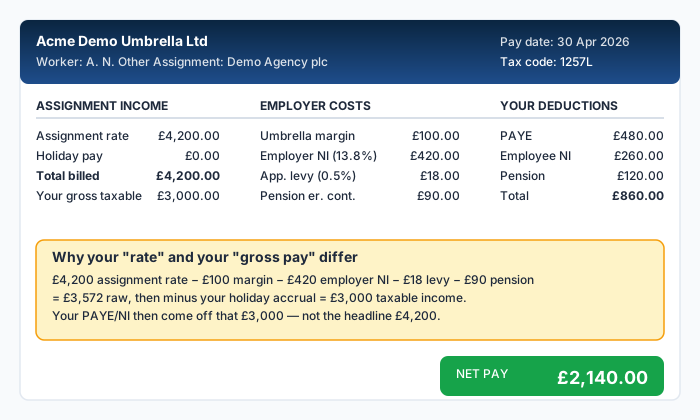
Umbrella company: the agency passes your pay to an umbrella company, which employs you and runs payroll. Your payslip comes from the umbrella, and employer costs (employer NI, pension, margin) are deducted before your gross pay is calculated. See our umbrella company payslip guide for details.
In both cases, you should receive a payslip for every pay period showing a full breakdown of earnings and deductions.
What deductions to expect
On an agency PAYE payslip:
- Income tax: calculated using your tax code, just like any other employment
- National Insurance: 8% on earnings between the Primary Threshold and Upper Earnings Limit
- Workplace pension: 5% employee contribution under auto-enrolment (if eligible)
- Student loan: if applicable, based on your plan type and threshold
On an umbrella payslip, you will also see employer costs deducted from the assignment rate before your gross pay is calculated.
Worked example (Agency PAYE)
You work 40 hours per week at £14 per hour through an agency on PAYE. In a 4-week pay period:
- Gross pay: 40 × 4 × £14 = £2,240.00
- Tax-free pay for four weeks on 1257L: £12,570 ÷ 52 × 4 = £966.92
- Tax: (£2,240.00 - £966.92) × 0.20 = £254.62
- NI threshold for four weeks: the weekly Primary Threshold is £242, so £242 × 4 = £968.00
- NI: (£2,240.00 - £968.00) × 0.08 = £101.76
- Pension (5% of qualifying earnings, weekly lower limit £120 × 4 = £480): (£2,240 - £480) × 0.05 = £88.00
- Net pay: £2,240 - £254.62 - £101.76 - £88.00 = £1,795.62
Note the two thresholds are not the same: income tax uses one fifty-second of the £12,570 Personal Allowance, while NI uses HMRC's published weekly Primary Threshold of £242. HMRC's tax tables round free pay to the penny, so your payslip may differ by a few pence.
Agency workers paid weekly will see smaller individual deductions than those paid monthly, but the annual totals should be equivalent. The tax calculation adjusts for the pay frequency.
The 12-week rule
Under the Agency Workers Regulations 2010, after 12 continuous weeks in the same role at the same hirer, you are entitled to the same basic pay and conditions as a permanent employee doing the same job. This includes:
- The same basic pay rate
- The same overtime rates
- The same holiday entitlement
- Access to the same facilities (canteen, parking, childcare)
If your pay does not increase after 12 weeks to match comparable permanent staff, raise it with your agency. The 12-week clock resets if there is a break of more than 6 weeks between assignments at the same hirer.
Holiday pay for agency workers
You are entitled to 5.6 weeks of paid holiday per year (pro-rated for part-time work). Agencies handle holiday pay in one of two ways:
- Accrued holiday pay: you accrue holiday entitlement as you work and take paid time off when you choose. This is the standard method.
- Rolled-up holiday pay: your holiday pay is included in your hourly rate and paid with each payslip. This was previously considered non-compliant but is now permitted under updated regulations, provided it is clearly shown as a separate line on your payslip.
Check your payslip for a line labelled "Holiday pay" or "Accrued holiday." If you cannot see it, ask your agency how your holiday pay is being handled.
If your agency is paying rolled-up holiday pay, make sure it is shown separately on your payslip and that the rate is correct (12.07% of your basic pay for 5.6 weeks of holiday). If it is bundled into your hourly rate without being itemised, you have no way to verify it.
Checking your agency payslip
Key checks to perform each pay period:
- Hours: verify the hours on your payslip match your timesheet
- Rate: check the hourly or daily rate matches your contract
- Deductions: calculate expected tax and NI and compare with the payslip
- Holiday pay: confirm it is being accrued or paid correctly
- Pension: check the contribution rate and whether it is being applied
To check whether those tax, NI and agency-fee lines look right on your own payslip, see How do I check my payslip is correct?.
If you find discrepancies, raise them with your agency's payroll department in writing. Keep copies of your timesheets as evidence.
Frequently Asked Questions
Do I get a P60 as an agency worker?
Yes. Whoever employs you (the agency or umbrella company) must provide a P60 after the end of each tax year, summarising your total earnings and deductions.
Can I claim expenses as an agency worker?
If you are employed by the agency or umbrella under supervision, direction, and control of the end client, you generally cannot claim tax relief on travel and subsistence expenses. This rule has been in place since April 2016.
What happens if my agency goes bust?
If your agency becomes insolvent, you may be able to claim unpaid wages, holiday pay, and notice pay from the National Insurance Fund through the Redundancy Payments Service. Contact Acas for guidance.
Am I entitled to sick pay as an agency worker?
You are entitled to Statutory Sick Pay (SSP) if you meet the eligibility criteria, regardless of whether you are on agency PAYE or an umbrella. Your employer (agency or umbrella) is responsible for paying SSP.
Can I be on a zero-hours contract through an agency?
Yes. Many agency roles are effectively zero-hours, meaning you are not guaranteed a minimum number of hours. However, you are still entitled to a payslip for every pay period in which you work, and all the standard deductions and rights apply.
Sources
Ready to check your own payslip?
Enter your figures and get an instant AI-powered analysis. Free, private, no signup.
Check my payslip freePayslipIQ provides educational information and estimated calculations only. It does not provide tax, legal, financial, payroll, accounting, pension, benefits or employment advice. Always verify your payslip, tax code, deductions and take-home pay with your employer's payroll department, HMRC, your pension provider, a qualified accountant, tax adviser or another appropriately qualified professional.