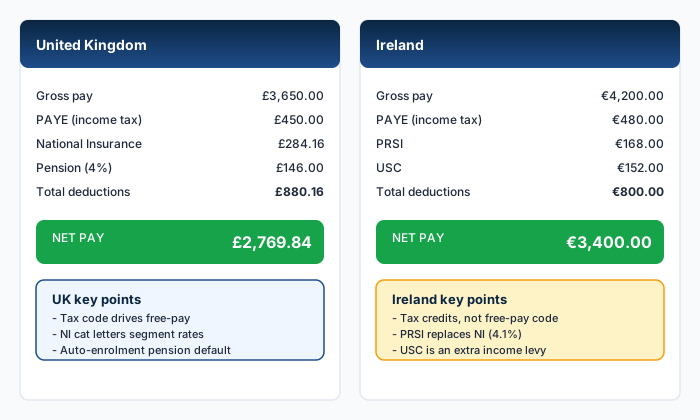
If you have moved between the UK and Ireland - or you work for a company with offices in both - you have probably noticed that the two payslips look superficially similar but use different mechanics. Both systems use PAYE, but tax bands, social insurance, and the way allowances are applied are surprisingly different. This guide breaks down each line, with a comparison table for the 2026/27 (UK) and 2026 (Ireland) tax years.
Last updated: 24 September 2026.
To check whether the tax, NI and PAYE lines look right on your own slip, see How do I check my payslip is correct?.
Want to check if your own payslip adds up?
Both call it PAYE - but they work differently
PAYE in the UK and PAYE Modernisation in Ireland share a name and a goal: tax collected at source through the employer. The plumbing differs.
- The UK uses a tax code (e.g. 1257L) that tells the employer how much tax-free pay to give each period
- Ireland uses tax credits and a Standard Rate Cut-Off Point (SRCOP), reported electronically through Revenue's Online Service (ROS)
- The UK runs cumulative calculations by default; Ireland also runs cumulative
- The UK has Scotland-specific bands (S1257L, S0T etc.); Ireland has no internal regional split
A UK employee gets a tax code by post or in their personal tax account. An Irish employee gets a Tax Credit Certificate (TCC) which the employer downloads automatically from ROS.
Tax codes vs tax credits
In the UK, your personal allowance reduces taxable pay before the rate is applied. In Ireland, the credit reduces the tax due after the rate has been applied. The maths can produce a similar result, but the appearance on the payslip is different.
- UK: Gross pay - allowance = taxable pay - tax = net
- Ireland: Gross pay - tax (calculated at full rate) + credits + USC + PRSI = net
This is why Irish payslips show "Tax credits applied" as a separate line, while UK payslips do not show the allowance at all - it is baked into the calculation behind the scenes.
National Insurance (UK) vs PRSI (Ireland)
Both fund state benefits, but the rates and bands differ.
UK National Insurance (2026/27)
Class 1 employee NI is charged on weekly or monthly pay above the Primary Threshold (£12,570 annualised):
- 8% on earnings between £12,570 and £50,270
- 2% on earnings above £50,270
There is no employer NI deducted from the employee. The employer pays Secondary Class 1 NI separately.
Irish PRSI (2026)
PRSI (Pay Related Social Insurance) is charged at a flat 4.2% on most Class A employee earnings, rising to 4.35% from 1 October 2026. A PRSI credit of up to €12 a week tapers away between weekly earnings of €352.01 and €424. There is no upper limit.
The employer pays separately: 9.00% on weekly earnings up to €552 and 11.25% above that, both rising by 0.15 points on 1 October 2026 to 9.15% and 11.40% (Department of Social Protection, PRSI contribution rates 2026).
Compared with UK NI, PRSI is simpler - one rate - and it keeps going at high incomes rather than dropping to a 2% marginal rate.
USC: the Irish line that confuses most expats
The Universal Social Charge has no UK equivalent. It is charged on virtually all gross income above €13,000, with rising bands. For 2026, the working assumption is:
- 0.5% on the first €12,012
- 2% on the next €16,688, so up to €28,700
- 3% on the next €41,344, so up to €70,044
- 8% on the balance
Source: Revenue, USC standard rates and thresholds.
USC was introduced in 2011 to consolidate two emergency levies. It looks like income tax but is calculated separately and reported on its own payslip line.
Worked example: same salary, two countries
A worker on a gross salary equivalent to £40,000 / €46,000 in 2026/27.
UK side (single, code 1257L):
- Gross monthly: £3,333.33
- Income tax: (£3,333.33 - £1,047.50) × 20% = £457.17
- NI at 8%: (£3,333.33 - £1,048.00) × 8% = £182.83
- Net pay: £2,693.33 a month
Ireland side (single, standard credits):
- Gross monthly: €3,833.33
- Income tax: €3,666.67 at 20% plus €166.66 at 40% = €800.00, less monthly credits of €333.33 (€2,000 personal and €2,000 PAYE) = €466.67
- USC: €912.82 a year across the 0.5%, 2% and 3% bands = €76.07
- PRSI at 4.2%: €161.00
- Net pay: €3,129.59 a month
The headline takeaway: the Irish system is heavier on social charges but slightly lighter on income tax for middle earners, and the UK system reaches the higher rate at a lower threshold. Read our guide on PAYE basics for more on how UK income tax is built up.
The Irish higher rate (40%) starts at €44,000 for a single person in 2026; the UK higher rate (40%) starts at £50,270. Currency aside, an Irish higher-earner crosses the band sooner.
Side-by-side comparison table (2026/27 UK / 2026 IE)
| Item | UK | Ireland |
|---|---|---|
| Income tax basic rate | 20% to £50,270 | 20% to €44,000 (single) |
| Income tax higher rate | 40% to £125,140 | 40% above €44,000 |
| Additional rate | 45% above £125,140 | None |
| Personal allowance | £12,570 | None - tax credit of €2,000 (2026) |
| Tax credit (if any) | None directly | PAYE credit €2,000, personal credit €2,000 |
| Social insurance (employee) | NI 8% / 2% | PRSI flat 4.2%, 4.35% from 1 Oct 2026 |
| Other charges | None | USC 0.5% / 2% / 3% / 8% |
| Pay frequency | Mostly monthly | Mostly fortnightly or monthly |
| Cumulative system | Yes | Yes (Week 1 also possible) |
| Tax code on payslip | Yes (e.g. 1257L) | No - replaced by SRCOP and credits |
| Pension relief | At source / net pay / sacrifice | Net pay (PRSA) or PAYE relief |
Pension treatment: another structural gap
UK occupational pensions usually use one of three methods: net pay, relief at source, or salary sacrifice. Irish pensions overwhelmingly use net pay - your contribution is deducted before tax but after USC. Both countries cap relief, but the limits work differently.
Read more in our pension contributions guide.
What changes if you move between the two
If you move from the UK to Ireland (or vice versa) mid-year, you may need to handle two systems:
- The UK issues a P45 when you leave
- Ireland issues a P45 equivalent (now electronic via ROS)
- Double Tax Treaties prevent you being taxed twice
- The UK and Ireland have a long-standing reciprocal social-insurance agreement
Make sure your new employer has the right starter information. In the UK, look for a BR or 0T tax code on your first payslip - it is often emergency until HMRC has your previous record. In Ireland, you will be on Week 1 basis until Revenue confirms your details.
A UK employee transferring to Ireland sometimes carries on paying NI under reciprocal agreement. Check your status with HMRC before assuming PRSI starts immediately. Getting this wrong can leave gaps in your state pension record on either side of the Irish Sea.
Calculators and further reading
You can pressure-test your UK figures with our income tax calculator and our NI calculator. For Irish PAYE, Revenue's PAYE Calculator is the official source.
Frequently Asked Questions
Why does my Irish payslip show tax credits but my UK one does not?
Ireland subtracts a credit after applying the rate; the UK subtracts an allowance before applying the rate. Both reduce your tax bill, but the order of operations is reversed.
Is PRSI the same as National Insurance?
They serve a similar purpose - funding state pensions and benefits - but PRSI is a flat 4.2% with no upper limit (4.35% from 1 October 2026), while UK NI uses 8% then 2% with thresholds.
Does Ireland have a personal allowance?
Not in the UK sense. Instead, you get a personal tax credit (€2,000 in 2026) and a PAYE employee credit (€2,000), which together act as a similar shelter against income tax.
What is USC and is it temporary?
USC is the Universal Social Charge, introduced in 2011 to replace the income and health levies. It was originally framed as temporary but has remained part of the Irish system. It is not deductible against pension relief or tax credits.
Can I be on both UK PAYE and Irish PAYE in the same year?
Yes, if you change jobs across the border. The Common Travel Area and the UK-Ireland Double Taxation Convention prevent you from being taxed twice on the same income.
Sources
Ready to check your own payslip?
Enter your figures and get an instant AI-powered analysis. Free, private, no signup.
Check my payslip freePayslipIQ provides educational information and estimated calculations only. It does not provide tax, legal, financial, payroll, accounting, pension, benefits or employment advice. Always verify your payslip, tax code, deductions and take-home pay with your employer's payroll department, HMRC, your pension provider, a qualified accountant, tax adviser or another appropriately qualified professional.