The pension line on a UK payslip is deducted in one of three ways: salary sacrifice, which reduces your gross pay before tax and NI are calculated and so saves both; a net pay arrangement, which is taken from gross before tax but after NI; or relief at source, taken from net pay, where the provider reclaims basic-rate tax for you.
Which one applies changes both your payslip and your tax bill. This guide walks through the three methods, the key terms, and the impact of the abolition of the Lifetime Allowance for the 2026/27 tax year.
To check whether the tax, NI and PAYE lines look right on your own slip, see How do I check my payslip is correct?.
Want to check if your own payslip adds up?
DC vs DB: what kind of scheme do you have?
Almost every workplace pension is one of two types:
- Defined Contribution (DC): you and your employer pay in, the money is invested, and the pot funds your retirement. Most modern UK schemes, including auto-enrolment NEST/People's Pension, are DC.
- Defined Benefit (DB): you pay in a fixed share, and the scheme promises a specific income in retirement based on salary and service. Public sector schemes (NHS, Teachers', Civil Service) are DB.
DC pots are pure money - you can see the balance any day. DB benefits are a promise rather than a pot, and the contribution rate is set by actuarial valuation rather than by you.
How each appears on your payslip
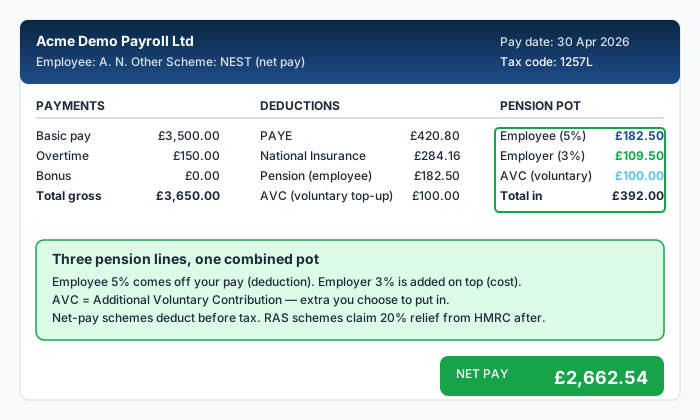
A DC contribution shows as a percentage of pensionable pay - typically 5% employee + 3% employer under auto-enrolment. The line might be labelled "Pension AE" or "Workplace Pension".
A DB contribution shows as a percentage too, but the rate depends on your salary band and the scheme rules. The NHS pension, for example, has tiered rates from around 5.2% up to 12.5%. The line is usually labelled with the scheme name (e.g. "NHS Pension Scheme").
Salary sacrifice vs net pay vs relief at source
This is the key distinction that decides how much tax relief you actually get. You should know which one applies to you - it changes both your payslip and your tax bill.
| Method | Gross pay shown on the payslip | Income tax relief | NI saving | Typically used by |
|---|---|---|---|---|
| Salary sacrifice | Reduced by the contribution | Given by the lower gross, at your marginal rate | Yes | Employers offering a sacrifice scheme |
| Net pay arrangement | Your full salary | Automatic: tax is calculated on gross minus pension | No | Most occupational schemes, including NHS, Teachers' and Civil Service |
| Relief at source | Your full salary | Provider reclaims the 20% basic rate; higher-rate taxpayers claim the extra 20% themselves | No | Personal pensions and many group personal pensions |
Salary sacrifice
You agree to give up part of your salary in exchange for an employer pension contribution. Your gross pay is reduced before tax and NI are calculated.
Effect on payslip:
- Gross pay is lower than your contractual salary
- Employee pension line may show £0 (because the contribution is now an employer contribution)
- Tax and NI are calculated on the reduced gross
- Saves both income tax and NI
This is the most efficient method. See our dedicated salary sacrifice guide.
Net pay arrangement
Your contribution is deducted from gross pay before tax is calculated, but after NI. You get income tax relief automatically; no NI saving.
Effect on payslip:
- Gross pay is your full salary
- Pension line shows your contribution as a deduction
- Tax is calculated on (gross - pension)
- NI is calculated on full gross
Most occupational schemes (including most NHS, Teachers', and Civil Service) operate this way.
Relief at source
Your contribution is deducted from net pay (after tax and NI). The pension provider claims back basic-rate tax (20%) from HMRC and adds it to your pot. Higher-rate taxpayers must claim the extra 20% themselves through Self Assessment.
Effect on payslip:
- Gross pay is your full salary
- Pension line shows your contribution as a deduction after tax
- Tax and NI are calculated on full gross
- Higher-rate taxpayers under-claim by default
Personal pensions and many group personal pensions (GPPs) use this method.
If you are a higher-rate taxpayer in a relief at source scheme and you do not file Self Assessment, you may be losing 20% relief every year - around £600 a year on a £3,000 contribution. You can claim by writing to HMRC if you do not file a return.
Employer match: the easy money to take
Auto-enrolment minimums are 5% employee + 3% employer, but many employers match higher contributions. Common patterns:
| Employer arrangement | Employee pays | Employer pays | Total into the pension |
|---|---|---|---|
| Auto-enrolment minimum | 5% | 3% | 8% |
| £1 for £1 up to 5% | 5% | 5% | 10% |
| £1.50 for £1 up to 6% | 6% | 9% | 15% |
| Sliding scale | Up to 10%, sometimes 15% | Set by the scheme | Set by the scheme |
Leaving a match unclaimed is one of the most expensive habits in UK payroll, and the money is gone every payday it happens. Take the £1.50-for-£1 row above: paying 6% yourself puts 15% of pensionable salary into the pension. Stay on the auto-enrolment minimum and you pay 5% for a total of 8%. You save one percentage point of your own pay and give up seven of your employer's.
Worked example: matched contributions in 2026/27
Salary £45,000, employer matches up to 5%.
- Employee 5% via salary sacrifice: £45,000 × 5% = £2,250 a year
- Employer 5% match: another £2,250 a year
- Tax saved (basic rate): £2,250 × 20% = £450
- NI saved (8%): £2,250 × 8% = £180
- Net cost to you: £2,250 - £450 - £180 = £1,620
- Total going into pension: £4,500 (employee + employer)
You spend £1,620 of take-home pay to get £4,500 invested. That is a 178% instant return before any market growth.
AVCs: paying in extra
Additional Voluntary Contributions are extra payments you can make on top of the standard scheme. They are most common in DB schemes, where contribution rates are fixed and AVCs are the only way to top up.
AVCs typically:
- Sit alongside the main scheme as a DC pot
- Receive the same tax treatment as the main scheme (net pay or relief at source)
- Can be taken as 25% tax-free cash from age 55 (rising to 57 from 2028)
- Are particularly useful for late-career boosters
Some schemes offer "Added Years" or "Added Pension" instead of AVCs, where you can effectively buy extra DB benefit. These are guaranteed but more expensive.
What about the Lifetime Allowance?
The Lifetime Allowance (LTA) was abolished for the 2024/25 tax year and remains gone in 2026/27. There is no longer a cap on the total pension benefits you can build up.
It has been replaced by:
The allowances that replaced the Lifetime Allowance
| Allowance | 2026/27 limit | What it caps |
|---|---|---|
| Lump Sum Allowance (LSA) | £268,275 | Tax-free cash across all your pensions |
| Lump Sum and Death Benefit Allowance (LSDBA) | £1,073,100 | Tax-free benefits payable on death |
| Annual Allowance | £60,000 | Contributions in a year, including your employer's |
| Money Purchase Annual Allowance (MPAA) | £10,000 | Contributions once you have flexibly accessed a DC pension |
The Lifetime Allowance was abolished on 6 April 2024 and replaced by the first two rows. If a scheme booklet or an older article still refers to a £1,073,100 Lifetime Allowance, it is describing a limit that no longer exists. Every figure re-read at HMRC on 27 September 2026.
The Annual Allowance is tapered for very high earners. See our Annual Allowance guide for the taper thresholds and carry-forward rules.
The LTA's removal does not mean you can pay in unlimited amounts every year. The Annual Allowance of £60,000 (which includes employer contributions) still bites, and breaching it triggers a tax charge at your marginal rate. Watch out if you receive a large bonus into a salary-sacrifice pension or change jobs into a DB scheme.
Spotting pension errors on your payslip
Common issues we see when checking payslips:
- Contribution rate not matching what you elected at enrolment
- Auto-enrolment "postponement" applied incorrectly, delaying contributions
- Employer match not applied because the election form was not processed
- Salary sacrifice running through old contractual salary after a pay rise
- Contribution paid by you but not yet visible in your pension provider's account
Cross-check your payslip with your pension provider's online dashboard once a quarter. Use our pension calculator to forecast end-of-career pot size.
Frequently Asked Questions
How do I tell which contribution method my pension uses?
Look at your payslip alongside the scheme booklet. If your gross pay is reduced by the pension amount, it is salary sacrifice. If gross is unchanged but tax is lower, it is net pay. If both gross and tax are unchanged, it is relief at source.
Does my employer pay tax on their contribution?
No, employer contributions are not taxable income to you and are not subject to NI. They go straight into the pension.
Can I increase my pension contributions mid-year?
Yes - most employers allow changes once or twice a year, sometimes monthly. Salary sacrifice changes usually require contract amendment but most providers handle this electronically.
What happens to my pension if I leave my job?
Your pot stays invested. You can leave it where it is, transfer it to a new employer's scheme, or move it into a SIPP. DB benefits are usually preserved as a "deferred pension" payable at scheme retirement age.
Should I opt out of auto-enrolment?
Almost never. You lose the employer contribution and the tax relief. The only exceptions are short-term contracts or if you would breach the Annual Allowance. See our auto-enrolment guide.
Sources
Ready to check your own payslip?
Enter your figures and get an instant AI-powered analysis. Free, private, no signup.
Check my payslip freePayslipIQ provides educational information and estimated calculations only. It does not provide tax, legal, financial, payroll, accounting, pension, benefits or employment advice. Always verify your payslip, tax code, deductions and take-home pay with your employer's payroll department, HMRC, your pension provider, a qualified accountant, tax adviser or another appropriately qualified professional.