Family-leave pay can make a payslip surprisingly hard to read. Half a dozen acronyms - SMP, OMP, SPP, ShPP, KIT - share the page, the gross pay drops, and yet the tax line might not. This guide walks through each pay type, how it appears on the slip, and what to check if you suspect you have been underpaid. Figures use the 2026/27 tax year.
To check whether the tax, NI and PAYE lines look right on your own slip, see How do I check my payslip is correct?.
Want to check if your own payslip adds up?
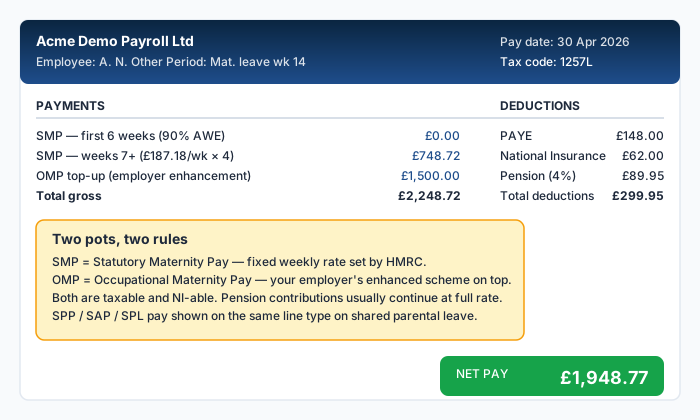
The acronyms in one place
Before we start, here are the abbreviations you will see:
| Acronym | Stands for | Set by |
|---|---|---|
| SMP | Statutory Maternity Pay | HMRC |
| OMP | Occupational Maternity Pay | Your employer, on top of SMP |
| SPP | Statutory Paternity Pay | HMRC |
| OPP | Occupational Paternity Pay | Your employer, on top of SPP |
| ShPP | Shared Parental Pay | HMRC |
| SAP | Statutory Adoption Pay | HMRC |
| SPBP | Statutory Parental Bereavement Pay | HMRC |
| KIT | Keeping in Touch days, during maternity or adoption leave | Your employer's policy |
| SPLIT | Shared Parental Leave in Touch days | Your employer's policy |
Each statutory payment is set by HMRC. Each occupational one is set by your employer's policy and sits on top.
Statutory Maternity Pay (SMP)
SMP runs for up to 39 weeks if you qualify (26 weeks' service by the qualifying week, average earnings above the Lower Earnings Limit).
The two SMP rates for 2026/27:
| Period of leave | SMP rate |
|---|---|
| First 6 weeks | 90% of average weekly earnings, with no cap |
| Next 33 weeks | The lower of 90% of average weekly earnings or £194.32 a week |
Source: HMRC, Rates and thresholds for employers 2026 to 2027. The rate is uprated each April.
After 39 weeks, statutory pay stops. The next 13 weeks of leave are unpaid unless your employer offers OMP that runs longer.
How SMP appears on the payslip
You will see a "SMP" or "Statutory Maternity Pay" line as gross pay. It is taxable income and subject to NI in the same way as salary. So the payslip still shows income tax and NI deductions - just calculated on a smaller gross.
If your employer adds OMP, you will see two separate lines:
- "SMP" (statutory portion)
- "OMP" or "Maternity top-up" or similar
OMP is fully taxable; nothing special happens at HMRC's end.
Worked example: month 3 of maternity leave (2026/27)
Average weekly earnings before maternity: £692.30 (i.e. £36,000 a year).
- Weeks 1-6: 90% × £692.30 = £623.07 a week
- Weeks 7-39: £194.32 a week (statutory cap)
- Monthly SMP in month 3 (weeks 9-12, all at statutory rate): £194.32 × 4.33 = £841.41 gross
If your employer offers OMP at full pay for the first 16 weeks:
- Full monthly pay: £36,000 ÷ 12 = £3,000.00
- OMP top-up in month 3: £3,000.00 - £841.41 = £2,158.59
- Total monthly gross: £3,000.00 (full pay)
Tax and NI are calculated on £3,000.00, not on £841.41 alone. The employer tops up to normal pay and reclaims the SMP element from HMRC; the payslip shows both lines, and the deductions are worked out on their sum.
SMP attracts the same tax and NI as salary. The Personal Allowance still applies, so months on SMP-only typically have very little or no income tax deducted. Check your YTD figures - underpayments often surface in cumulative tax that should have been refunded by month-end.
Statutory Paternity Pay (SPP)
SPP gives eligible fathers, partners or co-adopters up to two weeks of paid leave at the lower of 90% of average weekly earnings or the statutory rate. Since April 2024 the two weeks can be taken non-consecutively in the first year.
On the payslip:
- One or two SPP lines (depending on how the leave is split)
- Standard tax/NI applied
- May be combined with OPP if your employer offers a top-up to full pay
If you took your two weeks split across two months, you should see an SPP line in each month rather than a lump in one.
Shared Parental Pay (ShPP)
Shared Parental Pay lets you swap unused maternity or adoption pay to the partner. Up to 50 weeks of leave and 37 weeks of pay can be shared. The rate is the same statutory cap as SMP weeks 7-39: £194.32 a week in 2026/27.
To opt in, both parents have to give the employer written notice at least 8 weeks before. The leave can be taken in up to three blocks per parent.
On the payslip ShPP appears as a separate line, identifiable by the acronym. Like SMP, it is taxable and subject to NI.
When ShPP underpayments happen
The most common ShPP errors:
- The "8 weeks' notice" rule miscalculated, leading to leave being unpaid
- Statutory rate not uplifted at the April rate change
- Top-up (OShPP) not paid where the employer's policy explicitly says it should be
- ShPP weeks not deducted properly from the SMP balance (should reduce mother's remaining SMP)
If you suspect any of these, raise a formal grievance. Our payroll error letter template has a copy-paste version.
KIT and SPLIT days
KIT and SPLIT days let you work during leave without ending it.
| Day type | Applies during | Maximum |
|---|---|---|
| KIT | Maternity or adoption leave | 10 days |
| SPLIT | Shared parental leave | 20 days for each parent |
Pay rules:
- KIT/SPLIT days are paid at your normal day rate, not statutory
- The employer can offset against SMP/SPP/ShPP for that week (some do, some do not)
- They do not reset the parental leave clock
On the payslip you should see:
- A normal "Day rate" or "KIT day" line at full pay
- Possibly a reduced statutory line for the same week
This is one of the most common places people overpay tax inadvertently - the KIT day uplift can push them into a higher band for that month, with the cumulative system correcting later. Read our guide on why tax can spike.
Statutory Adoption Pay (SAP)
SAP mirrors SMP almost exactly:
- 90% of average weekly earnings for the first 6 weeks
- Statutory rate for the remaining 33 weeks
- Maximum of 39 weeks of pay
The same payslip rules apply. A reasonable employer policy adds OAP (Occupational Adoption Pay) to bring you up to full pay for some period.
Statutory Parental Bereavement Pay (SPBP)
Eligible parents who lose a child under 18 can claim two weeks of SPBP at the statutory rate. The pay appears as a single line on the payslip and is subject to tax and NI. The employer can add a contractual top-up if their policy supports it.
How to spot underpayment
A quick checklist when you suspect any family-leave pay is wrong:
- Was your "average weekly earnings" calculated over the correct 8-week reference period?
- Did the statutory rate change in April? Some employers forget to update the rate from week 1 of April onwards
- If you took leave in different tax years, did your tax code roll forward correctly?
- Are KIT/SPLIT days paid at full rate, not statutory?
- Has the contractual top-up policy been applied?
Run the figures through PayslipIQ's free checker for an instant cross-check. You can also use our take-home calculator to compare a normal-month payslip with a maternity-month payslip.
Statutory family-leave pay does not include any pension contribution from you. Your employer must continue paying their share based on your pre-leave salary. If your payslip shows reduced employer pension contributions during leave, query it - this is a common error in cloud payroll systems.
What about salary sacrifice while on leave?
Pension salary sacrifice cannot reduce SMP/SPP/ShPP below the statutory minimum. Childcare voucher and electric car salary sacrifice can technically continue, but the employer must continue providing the benefit at their cost during paid leave. Most employers freeze active sacrifices during family leave and resume on return.
Frequently Asked Questions
Is SMP taxable?
Yes. Statutory Maternity Pay is treated as earnings for income tax and Class 1 NI. Most months you pay very little tax because SMP is below the monthly Personal Allowance, but it still counts.
Will I get a tax refund during maternity leave?
Often yes. Your monthly gross pay drops below the Personal Allowance, the cumulative system rebalances, and your YTD tax is refunded over the leave period. You should see the refund as smaller (or zero) tax deductions in successive months.
Can I take all my paternity leave together?
Yes - you can take both weeks consecutively, or split them into two one-week blocks. The total cannot exceed two weeks within 52 weeks of the birth or placement.
What happens if my employer cannot afford to pay SMP?
HMRC funds 92% of SMP for most employers and 103% for small employers under the Small Employers' Relief scheme. Employers can apply to HMRC for advance funding if cash flow is an issue. You should be paid regardless.
Does maternity leave affect my pension?
Your contributions are usually based on your reduced pay, but the employer's contributions must be based on your pre-leave salary for any period of paid leave. This is set out in the Equality Act 2010.
Sources
Ready to check your own payslip?
Enter your figures and get an instant AI-powered analysis. Free, private, no signup.
Check my payslip freePayslipIQ provides educational information and estimated calculations only. It does not provide tax, legal, financial, payroll, accounting, pension, benefits or employment advice. Always verify your payslip, tax code, deductions and take-home pay with your employer's payroll department, HMRC, your pension provider, a qualified accountant, tax adviser or another appropriately qualified professional.