Running a side hustle on top of a salaried job is now mainstream. Whatever you do on the side - reselling, freelancing, dog-walking, content creation - HMRC takes the same view: extra income is potentially taxable. This guide walks through what changes on your payslip, when you need to register for Self Assessment, and how the dreaded K code can creep onto your main job if HMRC decides to tax your side income through PAYE.
To check whether the tax, NI and PAYE lines look right on your own slip, see How do I check my payslip is correct?.
Want to check if your own payslip adds up?
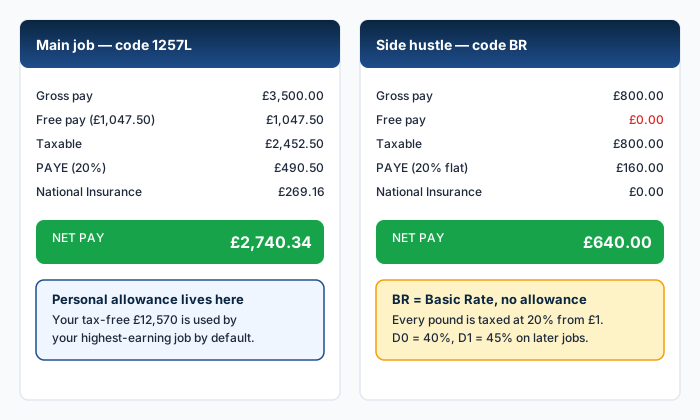
Does a side hustle change your payslip?
Most side hustles do not directly change your main payslip - they sit outside PAYE and are reported separately to HMRC. But there are three situations where they very much do:
- HMRC adjusts your tax code to collect side-hustle tax through your salary
- You start drawing a second wage that goes through a separate PAYE scheme
- A platform you sell on starts reporting your earnings to HMRC under the digital platform rules
If any of those apply, the deductions on your main payslip can change without warning. The first place this usually shows up is the tax code.
When HMRC pulls extra tax through PAYE
If you owe tax on side-hustle profits below a certain amount, HMRC can collect it by reducing your personal allowance on your main job. Your tax code is recalculated and a K code may appear if the adjustment exceeds your allowance. A K code means your "tax-free" amount is negative - you are taxed on more than you earn each month, because HMRC is using your salary to recover side income tax.
For example, if HMRC believes you owe £400 of tax on a side hustle, they might reduce your personal allowance by around £2,000, changing 1257L to 1057L. Your monthly tax bill goes up by roughly £33.
The £1,000 trading allowance
Every UK individual gets a £1,000 tax-free trading allowance per tax year. If your gross side income is under £1,000, you do not need to register for Self Assessment, and you do not pay tax on it. There is also a separate £1,000 property allowance for casual rental income.
A few things to watch:
- The allowance is gross (turnover), not profit
- You cannot claim the allowance and also deduct expenses - you pick one
- If you exceed £1,000, the allowance can still be used as a flat deduction instead of itemising costs
- Both spouses get their own allowance
Worked example: side hustle profit and tax
Imagine you earn £45,000 through PAYE in 2026/27 and make £3,500 selling handmade items on the side. Costs of materials and packaging are £600.
- Side-hustle gross income: £3,500
- Allowable expenses: £600 (or use the £1,000 trading allowance instead - whichever is higher)
- £1,000 trading allowance is the better choice: taxable profit = £3,500 - £1,000 = £2,500
- Your salary uses your full Personal Allowance, and you are still under the £50,270 higher-rate threshold by £5,270
- Tax on side profit: £2,500 × 20% = £500
- Class 4 NI is only payable on self-employment profits above £12,570 - so nothing here
- Class 2 NI is no longer payable as a flat rate from 2024/25 onwards for most profits
You declare the £2,500 on a Self Assessment return and pay £500 by 31 January 2028.
The £1,000 trading allowance is per person, not per side hustle. If you have three side businesses bringing in £400 each, the total £1,200 is over the threshold and you must register for Self Assessment - even though no single hustle exceeds £1,000.
When do you have to register for Self Assessment?
You must tell HMRC by 5 October following the end of the tax year in which the income arose if any of the following applies:
| What triggers registration | Threshold |
|---|---|
| Self-employed turnover | Above £1,000 |
| Untaxed income that cannot be collected through your tax code | £2,500 or more |
| Capital Gains tax to pay | Any amount |
| Child Benefit, under the High Income Child Benefit Charge | Income above £60,000 |
| Dividend income | Above the £500 dividend allowance |
For 2026/27, registration deadline is 5 October 2027 and the filing deadline is 31 January 2028. Miss it and you get an automatic £100 penalty even if no tax is owed.
What about the digital platform rules?
Since January 2024, platforms such as eBay, Vinted, Etsy and Airbnb report seller income to HMRC under the OECD digital platforms rules. Reporting kicks in if you make more than 30 sales or earn more than around £1,700 (€2,000) on a single platform in a calendar year. The reporting does not change your tax position - the £1,000 trading allowance still applies - but HMRC will know you sold and may compare it to your tax return.
Second job vs side hustle: a critical difference
A "second job" is a separate PAYE employment - your second employer deducts tax through their payroll. A "side hustle" is self-employment that you handle through Self Assessment.
The two have different mechanics:
| Second job | Side hustle | |
|---|---|---|
| Usual tax code | BR, taxing all earnings at 20% with no allowance; D0 (40%) or D1 (45%) if it pays well | None, because it stays outside PAYE entirely |
| When you pay the tax | Every payday, through your second employer's payroll | Annually, through Self Assessment |
| Effect on your main code | None by itself | HMRC may switch to "code-out" through your main job, generating a K code if the adjustment exceeds your allowance |
If you are unsure which one you have, look at your payslip - if there are deductions, it is PAYE; if you invoice a customer or get paid gross, it is self-employment.
How K codes appear when side-hustle tax is collected through PAYE
When HMRC decides to collect Self Assessment tax through your main payslip, they restate your code. If the recovery is small, you might see something like 1057L (allowance reduced from £12,570 to £10,570). If the recovery is large, your allowance turns negative and the code becomes K-prefixed. K475 means "add £4,750 to taxable pay" rather than subtracting it.
Worked example: how coding out feels on the payslip
You earn £40,000 with code 1257L, and HMRC needs to collect £600 of side-hustle tax through PAYE. At a 20% marginal rate, that means taking £3,000 off your allowance, so the code becomes 957L.
- Monthly allowance before: £12,570 / 12 = £1,047.50. Tax: (£3,333.33 - £1,047.50) × 20% = £457.17
- Monthly allowance after: £9,570 / 12 = £797.50. Tax: (£3,333.33 - £797.50) × 20% = £507.17
- Difference: £50 a month, which is the £600 recovered across the year
You see no extra deduction line; the entire effect comes from the code change. A K code only appears when the adjustment is larger than your whole allowance - K150 would mean adding £1,500 to your taxable pay on top of losing the £12,570, which at 20% would collect roughly £2,814 a year, not £600. If you see a K code for a small side-hustle bill, query it.
If you recently filed a Self Assessment return, check your next coding notice. HMRC tries to collect anything under £3,000 through PAYE by default. If you would rather pay the bill in one go in January, log into your personal tax account and untick "collect tax through PAYE".
Avoiding common side-hustle mistakes
A few patterns we see repeatedly when people check payslips on PayslipIQ:
- Mistaking the trading allowance for net profit (it applies to turnover)
- Forgetting that hobby reselling above £1,000 is still trading income
- Failing to register because "no profit was made" - HMRC requires registration even at a loss if turnover crosses £1,000
- Not budgeting for Class 4 NI (6% above £12,570 in 2026/27)
- Assuming a side hustle does not affect mortgage applications (lenders will see Self Assessment income)
You can model how a side hustle and a salary interact using our income tax calculator and pressure-test your monthly take-home with our take-home calculator.
Frequently Asked Questions
Do I have to declare side hustle income under £1,000?
No. If your gross side income (turnover, not profit) is below £1,000 in the tax year, the trading allowance covers it and you do not need to register or report. Keep records in case HMRC asks.
Will my main employer find out about my side hustle?
No - HMRC does not tell your employer what other income you have. They will only see a tax-code change. If you would rather not show a coding adjustment, you can ask HMRC to stop collecting through PAYE so your salary stays unaffected.
Is a side hustle classed as self-employment?
If you are providing goods or services with the intent of making a profit, yes, even if it is small. The "badges of trade" tests look at frequency, intention, and how you market the activity. Selling personal items occasionally is not trading; reselling for profit is.
Do I need a separate bank account for my side hustle?
It is not required, but strongly recommended. A separate account makes record-keeping easier, helps you justify expenses, and proves the activity is genuine if HMRC ever asks.
Can a side hustle push me into a higher tax bracket?
Yes. Side-hustle profits are added to your salary for the band test. If your salary is £45,000 and your side-hustle profit is £8,000, total taxable income is £53,000 - £2,730 of which falls in the 40% band. Plan ahead with our calculators.
Sources
Ready to check your own payslip?
Enter your figures and get an instant AI-powered analysis. Free, private, no signup.
Check my payslip freePayslipIQ provides educational information and estimated calculations only. It does not provide tax, legal, financial, payroll, accounting, pension, benefits or employment advice. Always verify your payslip, tax code, deductions and take-home pay with your employer's payroll department, HMRC, your pension provider, a qualified accountant, tax adviser or another appropriately qualified professional.