Overtime pay is taxed in the same way as your regular salary. There is no reduced rate or exemption for overtime earnings. When you work extra hours, the additional pay is added to your gross earnings for the period, and tax and National Insurance are calculated on the combined total.
To check whether the tax, NI and PAYE lines look right on your own slip, see How do I check my payslip is correct?.
Want to check if your own payslip adds up?
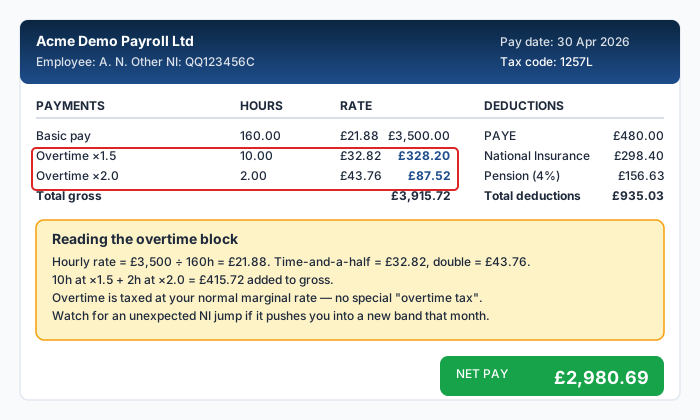
How overtime appears on your payslip
Most payslips show overtime as a separate line in the earnings section, distinct from your basic pay. You may see:
- Basic pay: your standard contractual hours at your normal rate
- Overtime: additional hours at your overtime rate (which may be time-and-a-half, double time, or your standard rate)
The two are added together to give your total gross pay for the period. Tax and NI are then calculated on this combined figure.
Worked example
You earn £2,000 per month basic pay on tax code 1257L. In March, you work 20 hours of overtime at time-and-a-half (your hourly rate is £12.50, so overtime is £18.75 per hour).
- Basic pay: £2,000.00
- Overtime: 20 × £18.75 = £375.00
- Total gross pay: £2,000 + £375 = £2,375.00
- Tax: (£2,375 - £1,047.50) × 0.20 = £265.50
- NI: (£2,375 - £1,048.00) × 0.08 = £106.16
- Net pay: £2,375 - £265.50 - £106.16 = £2,003.34
Without the overtime, the same payslip would read £2,000.00 gross, £190.50 tax, £76.16 NI and £1,733.34 net. The £375 of overtime therefore adds £270.00 to take-home pay - 72p in the pound, once 20% tax and 8% NI have come off. The income tax threshold here (£1,047.50, one twelfth of the Personal Allowance) and the NI threshold (£1,048, HMRC's published monthly Primary Threshold) are close but not identical.
Overtime is taxed at your marginal rate. If you are a basic-rate taxpayer, overtime is taxed at 20%. If overtime pushes your cumulative earnings into the higher rate band, the portion above the threshold is taxed at 40%.
Why overtime can look heavily taxed
If you work overtime regularly, you may notice that the tax on overtime months is higher than you expect. This is because the cumulative PAYE system calculates the total tax due on all your earnings to date, including overtime. A month with significant overtime increases the cumulative total, resulting in a higher tax deduction for that period.
The system self-corrects: if you work less overtime in subsequent months, the cumulative calculation will adjust and your tax will drop back. You will not permanently overpay because of a single high-overtime month.
Overtime and National Insurance
NI is calculated per pay period, not cumulatively. This means overtime in any given month increases your NI for that month, and there is no catch-up mechanism. If overtime pushes your earnings above the Upper Earnings Limit for the month (£4,189, HMRC's published monthly figure, not £50,270 divided by twelve), the portion above is charged at 2% instead of 8%.
Overtime and your pension
Whether overtime is included in your pension calculation depends on your scheme:
- Auto-enrolment on qualifying earnings: overtime is included in gross pay, so it increases your qualifying earnings and your pension contribution for the month
- Percentage of basic pay: overtime is excluded, and your pension contribution is based only on your basic salary
Check your pension scheme documentation or ask your HR department which method applies.
If your overtime is irregular, your pension contributions will fluctuate month to month under a qualifying earnings scheme. This is normal and does not indicate an error.
Checking overtime on your payslip
To verify your overtime pay:
- Multiply your overtime hours by the agreed overtime rate
- Check that the result matches the overtime figure on your payslip
- Add overtime to basic pay and verify the total gross figure
- Calculate expected tax and NI on the total gross and compare with the deductions shown
If the overtime rate on your payslip does not match your contract, raise it with your payroll department. Common errors include applying the wrong multiplier (for example, standard rate instead of time-and-a-half) or miscounting hours.
You can also run your figures through our payslip checker for a quick comparison.
Frequently Asked Questions
Is overtime taxed at a higher rate?
No. Overtime is taxed at the same rates as your regular pay. The rate depends on your total earnings for the year and which tax band they fall into. If overtime pushes you into a higher band, only the portion above the threshold is taxed at the higher rate.
Can my employer refuse to pay overtime?
Your right to overtime pay depends on your employment contract. There is no legal requirement for employers to pay a premium rate for overtime unless it is specified in your contract or a collective agreement.
Does overtime count towards my holiday pay?
Under UK law, regular overtime should be included in the calculation of holiday pay. This applies to both compulsory and voluntary overtime that is worked regularly. The calculation is based on average earnings over a reference period.
Will overtime affect my student loan repayment?
Yes. Student loan repayments are calculated per pay period on your gross pay. Overtime increases your gross pay for the month, which may increase the student loan deduction.
Should I check my overtime rate against the National Minimum Wage?
Yes. Your average hourly pay (including overtime) must not fall below the National Minimum Wage. If your overtime rate is lower than your standard rate, check that the blended average across all hours worked meets the minimum.
Sources
Ready to check your own payslip?
Enter your figures and get an instant AI-powered analysis. Free, private, no signup.
Check my payslip freePayslipIQ provides educational information and estimated calculations only. It does not provide tax, legal, financial, payroll, accounting, pension, benefits or employment advice. Always verify your payslip, tax code, deductions and take-home pay with your employer's payroll department, HMRC, your pension provider, a qualified accountant, tax adviser or another appropriately qualified professional.