If you are a Scottish taxpayer, your income tax is set by the Scottish Parliament rather than Westminster. Your tax code will have an S prefix (for example, S1257L), and your employer will apply Scottish rates and bands when calculating your PAYE deduction. This guide explains the current Scottish rates, how they differ from the rest of the UK, and how to check your payslip.
To check whether the tax, NI and PAYE lines look right on your own slip, see How do I check my payslip is correct?.
Want to check if your own payslip adds up?
Who is a Scottish taxpayer?
You are a Scottish taxpayer if your main home is in Scotland. HMRC determines this based on your registered address. If you live in Scotland but work in England (or vice versa), it is your home address that determines which tax rates apply, not your workplace.
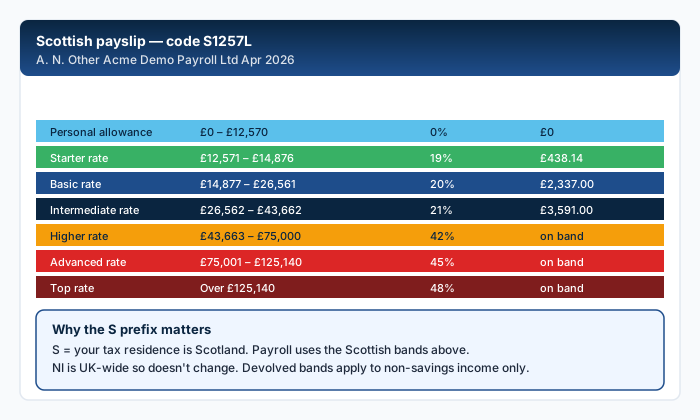
HMRC notifies your employer by issuing a tax code with an S prefix. If you see S1257L on your payslip, it means you have the standard Personal Allowance of £12,570 and Scottish tax rates apply.
Scottish income tax rates and bands for 2026/27
For the 2026/27 tax year, which runs from 6 April 2026 to 5 April 2027, the Scottish rates are:
| Band | Income | Rate |
|---|---|---|
| Starter rate | £12,571 to £16,537 | 19% |
| Basic rate | £16,538 to £29,526 | 20% |
| Intermediate rate | £29,527 to £43,662 | 21% |
| Higher rate | £43,663 to £75,000 | 42% |
| Advanced rate | £75,001 to £125,140 | 45% |
| Top rate | Above £125,140 | 48% |
Source: Scottish Income Tax, GOV.UK, 2026/27 rates. The figures assume the standard £12,570 Personal Allowance.
Compare this with the rest of the UK, which has only three bands (20%, 40%, 45%). Scottish taxpayers on lower incomes pay slightly less, because the 19% starter rate undercuts the rUK basic rate by a percentage point on the first £3,967 of taxable income - worth £39.67 a year. That advantage is then eaten away a penny in the pound by the 21% intermediate rate, which starts at £29,527. The crossover is £33,493: below it a Scottish taxpayer pays marginally less than someone on the same salary in England, above it marginally more, and from £43,663 the 42% higher rate opens a gap that widens with every pound.
Worked example
You earn £35,000 per year, paid monthly, on tax code S1257L.
- Taxable income: £35,000 - £12,570 = £22,430
- Starter rate (£12,571 to £16,537): £3,967 × 0.19 = £753.73
- Basic rate (£16,538 to £29,526): £12,989 × 0.20 = £2,597.80
- Intermediate rate (£29,527 to £35,000): £5,474 × 0.21 = £1,149.54
- Total annual tax: £753.73 + £2,597.80 + £1,149.54 = £4,501.07
- Monthly tax: £4,501.07 / 12 = £375.09
For comparison, the same salary under English rates would produce annual tax of £4,486.00 (£373.83 per month). The Scottish taxpayer pays £15.07 more a year - about £1.26 a month. The difference at this salary is small; it grows sharply once you pass £43,663 and the 42% higher rate applies.
National Insurance rates are the same across the whole of the UK. The S prefix on your tax code only affects income tax, not NI. Your NI deduction should be identical to someone on the same salary in England.
How to check your Scottish tax deduction
Because Scottish tax has six bands rather than three, the calculation is more complex. To verify your payslip:
- Calculate your annual taxable income (gross salary minus Personal Allowance)
- Apply each Scottish rate band in order
- Add up the tax from each band to get the annual total
- Divide by 12 for the monthly figure
- Compare with the tax shown on your payslip
Alternatively, use our payslip checker which applies the correct Scottish rates when you select the S-prefix tax code.
What if you have the wrong prefix?
If you live in Scotland but your tax code does not have an S prefix (or vice versa), your tax is being calculated using the wrong rates. This can result in over- or underpayment.
To correct it:
- Check your address with HMRC through your Personal Tax Account
- Update your address if it is wrong
- HMRC will issue a new tax code with the correct prefix
- Your employer will recalculate your tax cumulatively and adjust
If you moved between Scotland and England during the tax year, HMRC should update your tax code to reflect your new address. However, there can be a delay. Check your Personal Tax Account to ensure the change has been processed.
Scottish tax and the Personal Allowance
The Personal Allowance (£12,570) is set by the UK government and applies equally to Scottish taxpayers. The Scottish Parliament only controls the rates and bands above the Personal Allowance. The same tapering rules apply: for income above £100,000, the Personal Allowance is reduced by £1 for every £2 of income above that threshold.
Frequently Asked Questions
Do Scottish taxpayers pay more tax?
It depends on your income. Below about £33,500 you pay slightly less than your English counterpart, because the 19% starter rate outweighs the 21% intermediate rate at that level. Above it you pay more, and the difference grows once the 42% higher rate starts at £43,663 - nearly £7,000 earlier than the rUK 40% rate at £50,270.
Does the S prefix affect my National Insurance?
No. NI rates and thresholds are the same across the UK. The S prefix only affects income tax calculations.
I work in England but live in Scotland. Which rates apply?
Scottish rates apply. Your tax is determined by where you live (your main home), not where you work.
Can I choose to be taxed under English rates?
No. If your main home is in Scotland, you are a Scottish taxpayer and must pay Scottish rates. You cannot opt for a different set of rates.
How do I know if HMRC considers me a Scottish taxpayer?
Check your tax code. If it starts with S, HMRC considers you a Scottish taxpayer. You can also check your status through your Personal Tax Account on GOV.UK.
Sources
Ready to check your own payslip?
Enter your figures and get an instant AI-powered analysis. Free, private, no signup.
Check my payslip freePayslipIQ provides educational information and estimated calculations only. It does not provide tax, legal, financial, payroll, accounting, pension, benefits or employment advice. Always verify your payslip, tax code, deductions and take-home pay with your employer's payroll department, HMRC, your pension provider, a qualified accountant, tax adviser or another appropriately qualified professional.