There is a quiet line on most UK payslips that almost no-one understands: the bit where expense reimbursements, working-from-home allowances and benefits-in-kind sit. Get it wrong and you can be over- or under-taxed for years. This guide explains, in plain English, what should and should not appear in your taxable pay - using 2026/27 rates and rules.
Want to check if your own payslip adds up?
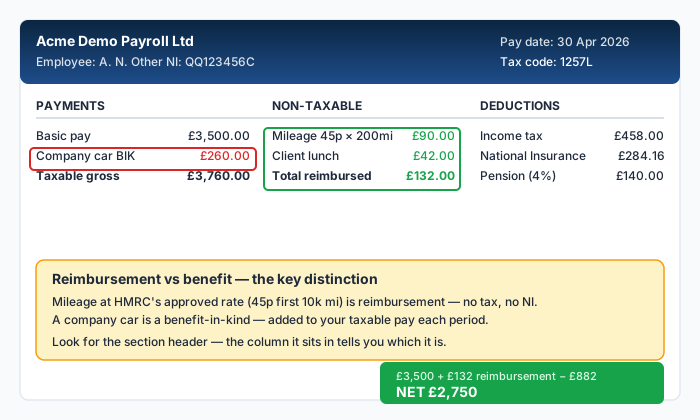
The two-column model: expenses vs benefits
Every payment your employer makes you falls into one of two columns:
- Expense reimbursement: paying you back for something you spent on the business. Not taxable, not on the payslip's "taxable pay" line.
- Benefit in Kind (BIK): providing you with something for personal use that has a money value. Taxable, usually via P11D or payrolled benefit.
The line between the two is where most errors happen. A company car is a benefit. A mileage payment for a personal car used for work is a reimbursement (up to a limit). A free lunch at the office canteen is a benefit (with exemptions). A taxi home after late-night work is sometimes a benefit, sometimes not.
Why the distinction matters on your payslip
Reimbursements should never appear in "taxable pay" - they should be a separate "expenses" line that does not affect tax or NI. If they do appear in taxable pay, you are paying tax on money you have already spent.
Benefits should appear either:
- On a P11D at year-end (HMRC then adjusts your tax code to recover the tax)
- "Payrolled" via your payslip during the year (BIK shown as taxable income but not as cash paid)
HMRC mileage rates: 55p and 25p from April 2026 (first rise since 2011)
If you use your own car for business journeys, your employer can reimburse you up to:
- 55p per mile for the first 10,000 business miles in the tax year (from 6 April 2026; 45p in 2025/26 and earlier)
- 25p per mile above 10,000 miles
- 24p for motorbikes, 20p for bicycles
These are "Approved Mileage Allowance Payments" (AMAPs). Up to these rates the reimbursement is tax- and NI-free.
If your employer pays more than the AMAP, the excess is a taxable benefit. If they pay less, you can claim Mileage Allowance Relief (MAR) for the shortfall through your tax return or a P87 claim.
Worked example: 12,000 business miles in 2026/27
You drive 12,000 business miles in your own car. Your employer pays a flat 60p per mile.
- First 10,000 miles at AMAP: 10,000 × 55p = £5,500
- Remaining 2,000 miles: 2,000 × 25p = £500
- Total approved amount: £6,000
- Employer paid: 12,000 × 60p = £7,200
- Excess (taxable benefit): £7,200 - £6,000 = £1,200 - reported on your P11D or payrolled.
The £1,200 is added to your taxable pay and shows on your P11D (or via payrolled BIK). The £6,000 is not.
If instead your employer paid only 30p per mile:
- Total received: 12,000 × 30p = £3,600
- Tax-free entitlement: £6,000
- Shortfall (you can claim relief): £2,400
- Tax relief at 20% basic rate: £480 refund
You claim this via P87 or Self Assessment.
HMRC raised the car AMAP rate to 55p for the first 10,000 miles from 6 April 2026 - the first change since 2011, announced in May 2026 and backdated to the start of the tax year. The over-10,000-mile rate stays at 25p. Any employer payment above the approved amount is still a taxable benefit.
Working-from-home allowance
Only one route survives for 2026/27, and it runs through your employer.
Your employer can pay you a homeworking allowance of £6 per week, or £26 per month if you are paid monthly, free of income tax and National Insurance, with no receipts required. More can be paid tax-free where the employer can evidence the higher cost (EIM01476).
What you can no longer do is claim the relief yourself. Section 360B ITEPA 2003 removed the employee deduction for unreimbursed homeworking costs from 6 April 2026, so there is nothing to claim for 2026/27 whether or not your employer pays the allowance (HMRC, removal of tax relief on non-reimbursed homeworking expenses; EIM32759).
The earlier years are still open
You have four years from the end of a tax year to claim, so during 2026/27 you can still claim for 2022/23 through to 2025/26. For those years the strict test applies: your employer had to require you to work from home, or have no office available to you. Choosing to work from home, or picking your own hybrid days, never qualified after April 2022. See our working from home tax relief guide for the claim route.
What appears on a P11D vs a payrolled benefit?
A P11D is the year-end statement of benefits in kind, filed by the employer with HMRC by 6 July following the tax year. Common items:
- Company car (cash-equivalent BIK based on list price and emissions)
- Private medical insurance
- Gym membership
- Living accommodation
- Beneficial loans (interest-free or low-interest)
- Mileage above AMAP
Payrolled benefits are an alternative: the BIK is added to your monthly taxable pay so that tax is collected through PAYE in real time. HMRC's "voluntary payrolling" scheme has been mandatory for most BIKs from April 2026 (with the exception of accommodation and beneficial loans, which remain on P11D).
This shift is a big deal: more BIK now appears on your monthly payslip rather than as a year-end tax-code adjustment.
Worked example: payrolled medical insurance
Your employer provides private medical insurance with a cash equivalent of £600 a year. Mandatory payrolling kicks in for 2026/27.
- Monthly BIK: £600 / 12 = £50
- Each month your taxable pay shows an extra £50 above your gross salary
- Tax at 20% basic rate: £10 a month
- NI: BIKs are not subject to employee NI, only Class 1A employer NI - so no NI deduction
- Annual tax cost to you: £120 (instead of £120 collected via tax-code adjustment)
You pay the same total tax, but in real time. The advantage is no surprise tax-code change in the following year.
Payrolled benefits look like a pay rise but they are not - the cash never reaches you. Check that your "Net pay" line still equals "Gross pay minus deductions minus BIK", not "Gross pay including BIK minus deductions". Some payroll systems mislabel the BIK as a deduction, double-counting it.
Common items that should NOT be in your taxable pay
If you spot any of these in the gross pay column, query it:
- Mileage at 55p/25p within AMAP limits
- Per-diem subsistence within HMRC scale rates
- £6/week homeworking allowance paid by your employer
- Reimbursement of business travel (taxis, train tickets, hotel for work)
- Trivial benefits below £50 a head (within rules)
- Eye tests for VDU users
- Reimbursed protective clothing or required uniform
A genuine "expenses" line is fine. A line in "taxable pay" labelled "Mileage" is not.
To check whether those expense, BIK, tax and NI lines look right on your own payslip, see How do I check my payslip is correct?.
Common items that SHOULD be in your taxable pay (or P11D)
- Company car BIK
- Private medical insurance
- Free or subsidised gym membership (not on-site staff facility)
- Cash bonus for completing training
- Vouchers (above the trivial benefit limit)
- Excess mileage above AMAP
- Excess subsistence above scale rates
If you are not sure, look for the line on your P60 vs your P11D - the totals should reconcile.
Salary sacrifice and BIK
Many salary-sacrifice schemes still show as BIK because they involve a benefit. The big exceptions, where there is no BIK charge, are:
- Pension contributions
- Cycle-to-work scheme
- Childcare vouchers (closed scheme, but still running)
- Workplace nursery
- Ultra-low emission vehicle (ULEV) salary-sacrifice cars (BIK is very small but not zero)
Read our salary sacrifice guide for the full mechanics. You can model your effective tax cost using our income tax calculator.
Frequently Asked Questions
Can my employer pay more than 55p per mile?
Yes, but anything above the AMAP rate is a taxable benefit. You can also negotiate fuel-only rates ("Advisory Fuel Rates") for company cars, which are different from AMAPs.
What if my employer reimburses me less than 55p?
You can claim Mileage Allowance Relief (MAR) on the shortfall via Self Assessment or a P87 form. The relief is at your marginal income tax rate. For backdated claims, use the rate that applied in that year - 45p for 2025/26 and earlier.
Is the £6 working-from-home allowance still available?
Your employer can still pay it tax-free at £6 a week or £26 a month. You can no longer claim it yourself: the employee deduction was withdrawn on 6 April 2026. Claims for 2022/23 to 2025/26 are still within time.
Does a company car always trigger a BIK?
Yes, unless private use is genuinely prohibited (and HMRC enforces this strictly - "pool car" exemption requires multiple users and overnight return to the employer's premises).
What happens if my P11D shows a benefit I never received?
Contact HR immediately. The P11D is filed with HMRC, and if you do nothing, your tax code will adjust to collect the wrong amount. Ask for a corrected P11D (or P11D(b) for the employer's Class 1A NI).
Sources
Ready to check your own payslip?
Enter your figures and get an instant AI-powered analysis. Free, private, no signup.
Check my payslip freePayslipIQ provides educational information and estimated calculations only. It does not provide tax, legal, financial, payroll, accounting, pension, benefits or employment advice. Always verify your payslip, tax code, deductions and take-home pay with your employer's payroll department, HMRC, your pension provider, a qualified accountant, tax adviser or another appropriately qualified professional.